This blog is no longer being updated and has been replaced by my new blog at jonathanemmett.com/blog

Thursday, 28 July 2016

Prince Ribbit • New Paperback & Hardback Picture Book


I have a new picture book coming out today in both hardback and paperback!

Prince Ribbit is illustrated by Poly Bernatene and published by Macmillan Children's Books. It's a comical twist on the classic Brothers Grimm fairy tale The Frog Prince.

When a cunning frog claims to be a bewitched prince, fairy-tale-loving princesses
Arabella and Lucinda take him into their home and treat him like royalty.
But fact-loving Princess Martha isn’t so sure;
her non-fiction books tell a different story.

Although Prince Ribbit is the fourth book that illustrator Poly Bernatene and I have created together, it’s effectively a follow-up to the second, The Princess and the Pig. While it’s not a sequel, both books are set in a fairytale world of princes and princesses and both books feature characters who are reading books of fairy tales.

In this new story a cunning frog inveigles his way into a royal household by pretending to be an enchanted prince. Romantically obsessed Princesses Lucinda and Arabella are only too happy to believe Prince Ribbit's story, but their younger sister Princess Martha is more sceptical.

Martha begins the story as an avid non-fiction reader but,
by the end, she's a fan of fiction as well.
Although fiction versus non-fiction is now a prominent theme of the story, there were no non-fiction books in the first few drafts. The only book that was referenced was Lucinda and Arabella's favourite fairy tale The Frog Prince, which provides Prince Ribbit with the inspiration for his cunning plan. In these earlier drafts, Martha succeeded in foiling Ribbit using nothing but her own reasoning and the story ended at an earlier point.

While I was fairly happy with this early version, Emily Ford, my editor at Macmillan, felt that the ending could be stronger and that the whole story was not as satisfying as the other ones I’d written for Poly to illustrate – and she was right! However it took me a while to find a way to achieve this and come up with a new draft that fitted the bill.

In the story, reading fiction helps Martha to find a solution to her problem; reading non-fiction helped me to find a solution to mine. At that time I was reading a lot of "popular science" books. It may surprise you to learn that libel laws do not apply to science and authors can misrepresent a scientist’s work with impunity. There are good reasons for this exemption, but it means that the label of “non-fiction” should not always be taken literally when it comes to scientific literature, particularly popular science books which can sometimes misrepresent evidence in order to appeal to a wider market. After digging a little deeper into the evidence, I discovered that some of the books I was reading at that time were doing exactly that and I often had to remind myself that, “Just because it’s in a book, it doesn’t mean it’s true!”. This phrase inspired the fiction versus non-fiction theme in the later drafts of Prince Ribbit and became a refrain within the story.

It was felt that this first version of the diagram of a frog's life cycle
 provided a little ‘too much information’ for younger readers so
the copulation stage was omitted from the final illustration.
While I loved the idea of playing off fiction against non-fiction, I didn’t want to show one type of book winning over the other – they’re both of equal value — so in the end Martha learns to appreciate both before foiling Prince Ribbit’s plan.

As always Poly has done a terrific job of illustrating the book, creating a cast of engaging characters in beautifully rendered settings. I particularly like the way that the illustrations in the books the characters are reading are drawn in a different style to the rest of the illustrations. Poly’s precisely detailed diagram of the life cycle of a frog would not look out of place in a real reference book, although Macmillan felt that his first version provided a little ‘too much information’ for younger readers (see image opposite).

When I first saw Poly’s roughs for the book I wasn’t keen on the car spread (shown below) and suggested that it would be better if the illustration show the royal tailors and jewellers attending Ribbit inside the palace. However Poly was reluctant to change it and — having now seen the finished illustration — I’m glad that he got his way, as it’s now my favourite spread in the book. I love the blue-yellow colour palette that Poly has used for this illustration, with the golden glow of the tailor’s shop spilling out into the half-light of the crowded street.


Here's a trailer I made for the book.


You can download and print out activity sheets for the book by clicking on their images below.


Word Search

Board Game


Buy this book at amazon UKBuy at amazon USBuy at amazon US

Thursday, 21 July 2016

Prince Ribbit • Asfordby Captain's Close Edition

Prince Ribbit illustrated by Captain’s Close School and Poly Bernatene Illustrated edition.

Regular readers of this blog may remember the post I wrote last year about a special edition of The Silver Serpent Cup illustrated by the children of Round Hill Primary School in Nottingham. Last month I ran a similar week-long project with my Patron of Reading school, Asfordby Captain’s Close Primary in Leicestershire.

At the beginning of the week, the children were given the text of Prince Ribbit, a picture book that will be published my Macmillan at the end of next week. The Macmillan edition is illustrated by Poly Bernatene, but the purpose of the project was to encourage the children to interpret the text for themselves and come up with their own illustration ideas, so the children were not shown any of Poly’s artwork until they had finished their own.

After introducing the story to the whole school and giving them a few top tips for illustration and page design, I spent a little time with each class to get them started. One of the main characters in the story is a frog, so I did some “How to draw a frog” sessions with Years 1, 2 and 3.

Then I spent some time thinking about characters and settings with Years 4, 5, & 6. I explained that there is no right way to illustrate a scene, but some ways might be better than others, so it’s always a good idea to consider alternative approaches before you start. As an example, we took one of Poly Bernatene’s illustrations for The Princess and the Pig and the children came up with lots of alternative "thumbnail" ideas to present the same scene to the reader.

Some of the children's alternative ideas for one of Poly's spreads from The Princess and the Pig

Each class then set about creating their own edition of the book, with each spread being illustrated by a different pupil. When they had finished, each teacher selected a complete set of illustrations from their class to make up six separate class editions of the book.

The covers designs for the six class editions.

There was some wonderful artwork in every edition. I could see that a lot of thought and imagination had gone into the character and spread designs and there was some imaginative use of typesetting from the older classes.

The Robins Class edition

I chose two or three pages from each of the class editions which I bound together to make an overall school edition of the book. I had a very hard time choosing just seventeen spreads for this and there were lots of excellent illustrations that I had to leave out.

Here are some of the spreads that I chose.

This front cover by Alex is very eye-catching and Ribbit has a slightly cunning look to him which is perfect for the story.
The back cover by Grace has some very engaging blurb and the Royal Library card is a great idea.

Prince Ribbit is a story about books and I really liked the way that George gives the reader a good look at the book Martha is reading on this spread.

This spread by Ona-Mae is very professional-looking, with some great character designs and expressive faces.

We finished off the week with a special assembly on Friday afternoon. After revealing the illustrations I’d chosen for the school edition, I showed the children the published edition so that they could see how Poly Bernatene had tackled each of the spreads they'd been working on.

Me showing the children Poly's illustrations for the book

I’d explained at the beginning of the week that we would choose one favourite spread from the school edition, the illustrator of which would receive a signed copy of the Poly Bernatene illustrated edition. As the illustrator, Poly was much better qualified to make this decision than I was, so I emailed him a pdf version of the school edition and he sent back a video in which he announced the winning illustrator …

Illustrator Poly Bernatene sent us a video to announce his favourite illustration from the school edition.

… which was Scarlett from Robins Class who produced this wonderful illustration showing Princess Martha in the Royal Library.

Poly chose this spread by Scarlett as his favourite 

The project was a very effective way for the children to learn a little about the ins and outs of book design and illustration and gave them a new appreciation of all the thought and hard work that goes into turning a text into a finished book.

I’d like to say a big THANK YOU to all the young illustrators, their teachers and TAs and Literacy Co-ordinator Miss G, who did such a brilliant job of co-ordinating the project in the school.

Me with the 17 illustrators of the school edition


Prince Ribbit is published on Thursday 28 July 2016 by Macmillan Children's Books.

Click here to find out more about the book


Buy this book at amazon UK Buy at amazon US Buy at amazon US

Sunday, 19 June 2016

WHAT LIES WITHIN: Cross sections and cutaways in picture books.

This post was originally published on Picture Book Den, a blog about picture books by picture book authors and illustrators.


Two types of pictures that were guaranteed to hold my attention as a child were cross sections and cutaways. These revealing illustrations offered readers a god-like omniscience allowing them to peek at things that were usually hidden and imparting an understanding of how individual parts or spaces fitted together to form a more complex whole.

If you’re not clear on what the difference is, a cross section is a drawing which shows the view revealed by an imaginary straight line slice through an object, while a cutaway is a drawing in which some external parts have been removed (or ‘cut away’) to reveal the interior. Many of the drawings featured in “cross section” books are actually cutaways.

One illustrator who did a great deal to popularise cutaways was Leslie Ashwell Wood. Although perhaps best know for the hundreds of cutaways he created for the Eagle comic in the 1950s and 60s, Wood also produced a series of Inside Information books including this one featuring cutaways of space craft, which I spent many hours poring over as a child.

Inside Information on Space Travel was part of a series of twelve
Inside Information cutaway books illustrated by Leslie Ashwell Wood 

There was a quite a craze for cross sections and cutaway books in the 1990s, perhaps most notably the Incredible Cross Section series illustrated by Stephen Biesty.

Stephen Biesty’s intricately detailed exploded cutaway through the Colosseum from
Rome in Spectacular Cross-Section with text by Andrew Solway.  


While Biesty’s drawings revealed the hidden intricacies of the real world, past and present, other illustrators began to produce equally detailed cross sections and cutaways based on the fictional worlds of films and TV shows. In 1998 Dorling Kindersley published Star Wars: Incredible Cross-Sections, illustrated by Hans Jensen and Richard Chasemore and written by David West Reynolds. 


Hans Jenssen’s Millennium Falcon cutaway from Star Wars: Incredible Cross-Sections.

Since then everything from the Thunderbirds' rescue craft to Wallace and Gromit’s motorbike and sidecar has been laid bare in cutaway or cross section form.

An amusing variation on the genre is
 Alan Snow’s How Things Really Work series which purports to show the mechanical interior workings of familiar creatures.


 A cross section though a Stegosaurus from Alan Snow’s How Dinosuars Really Work

Although some of the books featured above contain fictional content, none of them are story books, so I thought I’d finish off by looking at some picture books that incorporate cross-sections into a narrative.

Now that you know what a fan I am, you probably won’t be surprised to learn that cross sections and cutaways occasionally pop up in the picture books I've written, such as this wonderfully detailed crocodile-submarine gatefold that Steve Cox created for The Treasure of Captain Claw.

Captain Claw's crocodile-like submarine (click here to see a larger version).

Chris Riddell’s cutaway drawing for Pirate Diary, written by Richard Platt, allows readers to explore the ship on which the story is set … 


… as does this Noah’s Ark cross section (made from plasticine!) by Barbara Reid for her picture book Two By Two.


But no post about cross sections and cutaways in picture books would be complete without a mention of the two Full Moon books – Full Moon Soup and Full Moon Afloat – by Alistair Graham. These are both wordless picture books in which the story is told in a sequence of twelve comically detailed cross sections populated by a cast of increasingly weird and wonderful characters. In Full Moon Soup the eponymous magical potion results in a Fawlty-Towers-like hotel going from this at the start of the book … 


… to this by the end. 


I hope you've enjoyed this 'slice' of some of my favourite picture book cross sections and cutaways. If you have any favourites of your own, I’d love to hear about them in the comments box below. 


The submarine cross section featured above is taken from
The Treasure of Captain Claw, illustrated by Steve Cox and published by Orchard Books.


Find out more about The Treasure of Captain Claw on my web site


Thursday, 5 May 2016

A SPOT OF BOTHER - Now out in paperback!

A Spot of Bother, the last picture book I created with the late Vanessa Cabban has just been published in paperback by Walker Books.

The story is a follow up to The Pig’s Knickers and features the same cast of characters. In this story Pig is horrified to discover that his spotless appearance has been spoiled by a cherry stain. His friends try to help, but the more they try to clean the spot, the bigger it gets. Things go from really-not-that-bad to genuinely awful as Goat, Cow and Sheep try to help Pig rid himself of the ever spreading spot.

Here's what reviewers said about the hardback edition:

"There is fun aplenty in the pages of this charismatic picture book which is guaranteed to have youngsters positively snorting with laughter."
"The action is beautifully portrayed in Vanessa Cabban’s wonderful watercolour illustrations. … The tone of the telling is spot on too: a fantastic author/artist collaboration."
Jill Bennett, RED READING HUB

And here's a trailer for the book.


Vanessa did another great job on the book's illustrations, deftly capturing Pig’s emotions as he goes from satisfaction to despair and back again. Here are a couple of spreads.


Click the image below to download a Spot to Spot activity sheet for this book.

Click image to download activity sheet

Click here to go to my website to download and make this pig mask.


Wednesday, 23 March 2016

Why we hope authors and illustrators will stop promoting climate-wrecking companies like Emirates Airline

The post below was originally written for the news page of the Think Twice campaign web site. The campaign, which was instigated by book blogger Zoe Toft and myself, encourages authors and illustrators to 'think twice' about attending the Emirates Airline Festival of Literature in Dubai on the grounds that the festival is sponsored by an environmentally unfriendly company owned by an oppressive government.

With this year’s festival now over, we are winding down the campaign. However the Think Twice website will remain online and we will continue to accept new signatories to our pledge.

The principle aim of this campaign was to raise awareness of the three key issues highlighted on our homepage, which we have achieved. The debate the campaign provoked online (and off-line) has helped to highlight the oppression of free speech and human rights in the UAE as outlined in English PEN and Human Rights Watch’s open letter to festival patron Sheik Mohammed, which was published as the festival drew to a close.

We’re pleased to say that the response to the campaign has generally been very positive, however there have been some exceptions. Critics of the campaign have argued that the festival promotes cultural exchange and a love of literature. We accept this point, but the same could be said of all book festivals, most of which give these same benefits without lending their respectability to a sponsor who is so morally reprehensible. The fact that this particular festival presents itself as promoting free speech, while being funded by a government that is brutally suppressing free speech among its own citizens, seems especially inappropriate. In short, we don’t accept that sponsorship by an environmentally unfriendly company owned by an oppressive government is a “necessary evil” that authors should be prepared to accept in return for a book festival.

The one major regret we have about the campaign is that we were unable to get more authors and illustrators to engage with the issue of aviation-induced climate change. Some people have suggested that it was inappropriate to combine climate change and human rights issues in the same campaign. We disagree entirely; climate change is very much a human rights issue. Amnesty International have described climate change as “one of the greatest human rights challenges of our time". Savio Carvalho, Amnesty’s Senior Advisor on International Development and Human Rights addresses the subject thus in this article:
“What has climate change got to do with human rights?
Extreme weather-related disasters and rising seas will destroy homes and ruin people’s ability to earn a living. What’s more, unless emissions are reduced significantly, around 600 million people are likely to experience drought and famine as a result of climate change. So you can see there’s a direct link between climate change and human rights, including the rights to life, health, food, water and housing.”
Climate scientists and environmental campaigners have made it clear that the continuing growth of the aviation industry is critically undermining efforts to keep global warming beneath the 2ºC limit needed to avert climate catastrophe. Earlier this week, the World Wildlife Fund, Transport and Environment (a coalition of European environmental organisations) and other environmental groups launched the FlightPath 1.5 campaign to address “the defining global climate change issue of 2016: reducing greenhouse gas emissions in the airline industry.” As well as urging world leaders to confront the aviation industry, the campaign aims to educate “the public about the importance of this unaddressed issue".

The FlightPath 1.5 campaign aims to educate the public about threat posed by aviation-induced climate change. 

The problem is that, while domestic flights are covered by the carbon budgets of individual nations, international flights are not. So, while other industries have been working hard to reduce their CO2 emissions, the aviation’s industry’s emissions have more than doubled in the last twenty years. The festival’s sponsor, Emirates Airline, have led the way in exploiting this loophole, outstripping all other airlines by a considerable margin. The international passenger kilometres flown in 2015 by the top 5 international carriers are shown in the graph below.


And, rather than curb their growth, Emirates have announced plans to double the size of their fleet. As such, Emirates are by far the worst offenders in an industry that has consistently prioritised corporate profit ahead of the welfare of future generations.

Setting the issue of ethical sponsorship aside, we hope that this campaign will help authors and illustrators who are genuinely concerned about climate change to recognise the immense impact air travel may be having on their personal carbon footprint. One Emirates Festival author's return flight from London to Dubai generates almost as much CO2 as the average UK citizen produces in an entire year and more than three times the CO2 produced by the average Indian citizen*. For authors and illustrators who fly once a year or more, probably the most effective thing they can do to help combat climate change will be to cut back on their flying.

For many authors and illustrators this may mean attending fewer international festivals and conferences in person (regardless of their sponsorship). The academic community are already leading the way in this respect. The Flying Less campaign is helping to reduce flying by members of academic institutions and professional associations. Launched in October last year, it already has 352 signatories. In the interests of future generations, we hope that the literary community will also recognise the urgent need to cut back on its flying.


* The Emirates Airline Festival of Literature flies UK authors to Dubai by Business Class on Emirates Airlines.
Heathrow to Dubai Business Class return trip on a scheduled flight = 5.106 tonnes CO2 emissions
(Source: Atmosfair emissions calculator 2019 https://www.atmosfair.de/en/)
Per capita annual CO2 emissions: UK 5.65 tonnes, India 1.57 tonnes
(Source: Statista 2016 figures https://www.statista.com/chart/16292/per-capita-co2-emissions-of-the-largest-economies/)

Wednesday, 16 March 2016

TO BOLDY GO: Picture books in space

This post was originally published on Picture Book Den, a blog about picture books by picture book authors and illustrators.


As someone who grew up at the time of the Apollo Missions I’ve always found the idea of space travel hugely appealing and had a particular interest in stories that are set in space.

I've pitched several space-set stories to publishers over the years. However, while I’ve had some success getting space-set chapter fiction published …

The Captain Comet chapter fiction books illustrated by Andy Parker are set in space.

… none of the space-set picture books I’ve pitched have ever made it into print.

An art sample by illustrator Steve Cox for Invasion of the Botty Snatchers,
an unpublished space-set picture book we developed together.

Of course this could be because none of them were any good, but when another of my space-set picture book ideas was turned down last year, the publisher told me that one of the reasons was that, “picture books set in space generally don’t sell.”

If this is true, then I think it shows that the picture book market is currently catering to the tastes of a demographic that is relatively narrow compared to its potential readership. There are plenty of picture book age children that are interested in stories set in space. However these children are currently having this appetite fed by TV shows and films rather than books. My son and several of his friends were obsessed with the original U certificate Star Wars trilogy from the age of four and when I went to see the new Star Wars film over Christmas, I was struck by how many parents had brought small children to see it, despite its 12 certificate rating.

If publishers want to show these children that picture books are every bit as capable of matching the appeal of their favourite films and TV shows, they might consider “boldly going” into space a little more often. And I do mean “boldly”; it’s not just the setting that’s important. There is a market for gentler picture book stories set in space, but such books will not cut it with young readers with an appetite for dogfights and death stars. These children need picture books that can match the dastardly villainy, thrillingly perilous predicaments and sophisticated craft and weaponry evident in films like Star Wars.

Here are three space-set books that are a good deal “bolder” than most.


The King of Space written and Illustrated by Jonny Duddle is one of the best picture books of the last ten years and shamefully under-recognised by reviewers and awards judges alike. It’s a brilliantly illustrated, tech-tastic, action packed epic, filled with battling spaceships, menacing robots and a pint-sized megalomaniac.


The hardback edition comes with a dust-cover that unfolds to make this awesome poster of a 'warbot'.


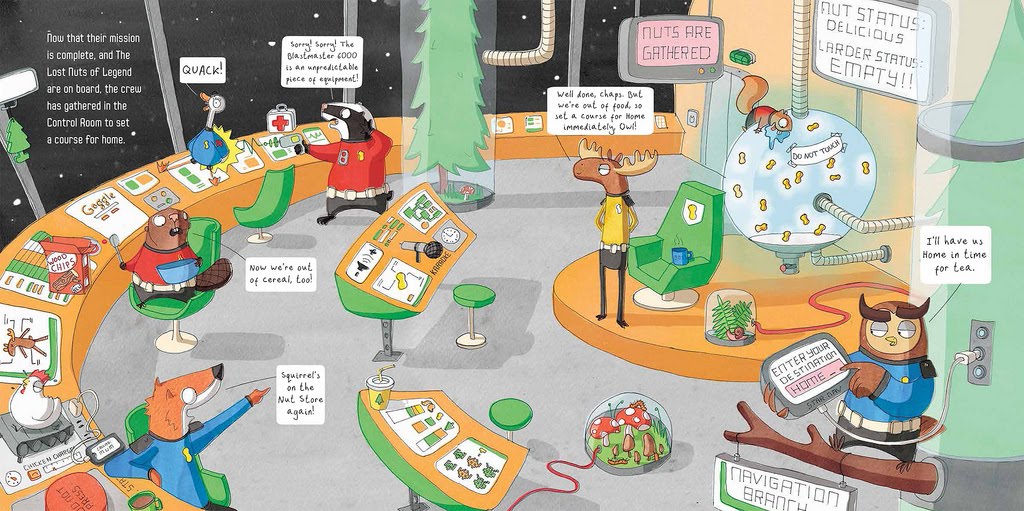
Nuts in Space written and illustrated by Elys Dolan is a madcap space epic that's brimful of comic references to both Star Wars and Star Trek. Charged with transporting “The Lost Nuts of Legend” across the galaxy, the crew of Forest Fleet’s finest starship encounter a mischievous menagerie of creatures from little green men to ravenous Ewok-like bears, before falling into the clutches of Daft Monkey and his legion of simian stormtroopers.


The book is full of amusing in-jokes for sci-fi fans young and old, such as this encounter between Daft Monkey and Commander Moose.


Mungo and the Spiders from Space written by Timothy Knapman, illustrated by Adam Stower is part of an excellent series of Mungo stories in which Mungo, the young hero, enters the world of a favourite bedtime book. In this story it's a comic book adventure featuring a Dan-Dare-like space hero called Captain Galacticus.


Galacticus and Mungo join forces to thwart the villainous, Dr Frankenstinker, the "maddest scientist on Mercury".


Can you recommend any other picture books that "boldly go" into space? If so, I'd love to hear about them in the comments box below.