This blog is no longer being updated and has been replaced by my new blog at jonathanemmett.com/blog

Showing posts with label The Pig's Knickers. Show all posts

Thursday, 5 May 2016

A SPOT OF BOTHER - Now out in paperback!

A Spot of Bother, the last picture book I created with the late Vanessa Cabban has just been published in paperback by Walker Books.

The story is a follow up to The Pig’s Knickers and features the same cast of characters. In this story Pig is horrified to discover that his spotless appearance has been spoiled by a cherry stain. His friends try to help, but the more they try to clean the spot, the bigger it gets. Things go from really-not-that-bad to genuinely awful as Goat, Cow and Sheep try to help Pig rid himself of the ever spreading spot.

Here's what reviewers said about the hardback edition:

"There is fun aplenty in the pages of this charismatic picture book which is guaranteed to have youngsters positively snorting with laughter."
"The action is beautifully portrayed in Vanessa Cabban’s wonderful watercolour illustrations. … The tone of the telling is spot on too: a fantastic author/artist collaboration."
Jill Bennett, RED READING HUB

And here's a trailer for the book.


Vanessa did another great job on the book's illustrations, deftly capturing Pig’s emotions as he goes from satisfaction to despair and back again. Here are a couple of spreads.


Click the image below to download a Spot to Spot activity sheet for this book.

Click image to download activity sheet

Click here to go to my website to download and make this pig mask.


Friday, 27 March 2015

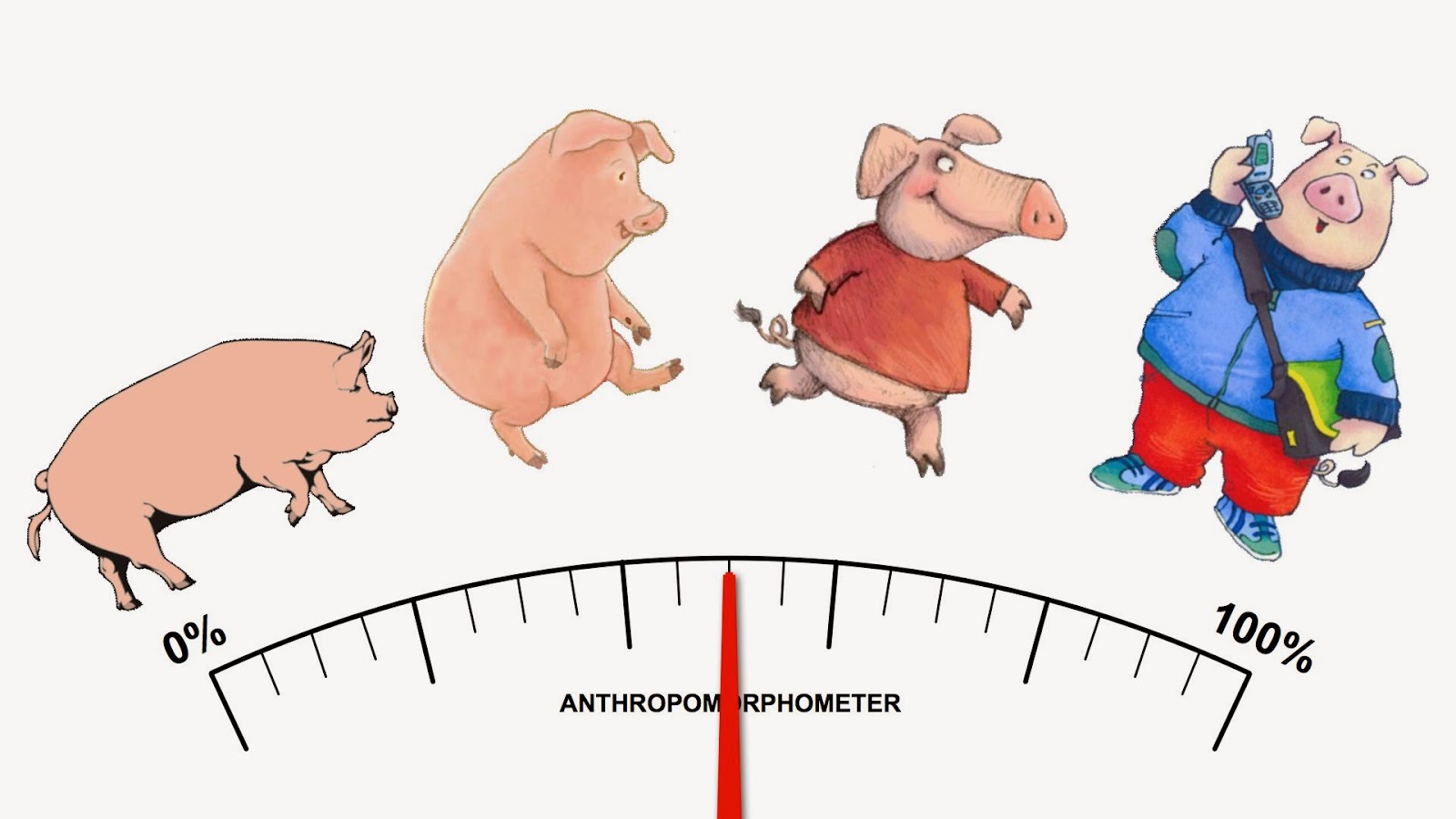
Drawing the anthropomorphic line: how human should your characters be?

This post was originally published on Picture Book Den, a blog about picture books by picture book authors and illustrators.


Drawing the anthropomorphic line 

The “Pig Tales” session I often do on my school and library visits features three picture books I’ve written about pigs. In between reading the three stories I explain that one of the things that makes them different from each other is how much anthropomorphism they use. I explain what this ridiculously long word means and why it’s such a useful tool for storytellers.


The dictionary definition of anthropomorphism is “the attribution of human characteristics or behaviour to a god, animal, or object.” I tell the children that anthropomorphism is simply “making something more like a person.”

Many of mankind’s oldest stories come from Africa, the birthplace of the human race. In the African stories of Anansi the spider, Anansi thinks and speaks like a human and in some of the stories he takes on human form.

Anansi the Spider: A Tale from the Ashanti by Gerald McDermott

Storytellers have been using anthropomorphism – making animals think, talk and look like humans – ever since.

Lucy Cousins's Maisy Mouse

And it’s not just animals – you can anthropomorphise almost anything … 


… vegetables …


… vehicles …


… even household appliances!

One reason storytellers use anthropomorphism is because people usually find characters more appealing if they think they are like them. Anthropomorphising an animal or even a toaster makes us care about what happens to them.

Anthropomorphism is not an either-or option; you can vary the amount you use. And, if you are creating a picture book, it’s worth taking the time to get the balance just right in both text and illustrations.

You can use varying amounts of anthropomorphism

My picture book story Pigs Might Fly is a sequel to the traditional tale of The Three Little Pigs. The pigs in my story build and fly aeroplanes, so they are fully anthropomorphic – the story could just as well be about three humans. This was reflected in some of illustrator Steve Cox’s first character sketches for the book, where the pigs are fully clothed and one of them is carrying a phone and a laptop. However, the publisher felt that these characters didn’t have quite the right appeal, and the character designs that eventually appeared in the book wore less clothing and were more recognisably pig-like.

Some of Steve Cox's character sketches for Pigs Might Fly:
Early, fully-anthropomorphic characters on the left and final characters on the right.

The pig in The Pig’s Knickers lives outdoors on a farm and – before the events of the story – would not usually wear clothing. However I made him talk, think and feel like a human in the text and Vanessa Cabban’s illustrations show him dancing on his hind legs and picking things up with his front trotters. As such, he’s a good example of a semi-anthropomorphic character.

One of Vanessa Cabban's illustrations for The Pig's Knickers

The Princess and the Pig is the story of a piglet that gets switched at birth and is brought up as a princess in the mistaken belief that she has been bewitched. The running joke in the story is that, while the reader knows that Princess Priscilla is nothing more than an ordinary pig, the characters in the story don’t and spend all their time trying to make her look and behave like a human. When I first started thinking about the story I considered making Priscilla a little anthropomorphic, but in the end I decided that the story would be much funnier if I didn’t anthropomorphise her at all.

One of Poly Bernatene's spreads for The Princess and the Pig

So the next time you’re writing a story with animal* characters, take a moment to think about where’s the best place to draw your anthropomorphic line!


*Or vegetables or vehicles or household appliances!


My latest semi-anthropomorphic picture book is A Spot of Bother illustrated by Vanessa Cabban and published by Walker Books.


find your local bookshopBuy this book at amazon UKBuy at amazon US

Monday, 2 February 2015

A Spot of Bother • Picture Book

I have a new picture book coming out this Thursday!

A Spot of Bother is illustrated by my longtime collaborator Vanessa Cabban and published by Walker Books. The story is a follow up to The Pig’s Knickers and features the same cast of characters including the rather self-centred Pig. In this story Pig is horrified to discover that his spotless appearance has been spoiled by a cherry stain. His friends try to help, but the more they try to clean the spot, the bigger it gets.

I knew as I was writing The Pig’s Knickers that I would want to revisit the characters, but my original intention was that each of the subsequent stories would be centred on a different animal. So the first follow-up story I wrote was about Sheep rather than Pig. However my publishers at Walker books didn’t feel that the Sheep story was quite right, so I wrote another story, this time with Goat as the central character. Once again Walker felt that the story fell short of the mark. So for the third attempt I returned to Pig and fortunately it turned out to be third time lucky!

Pig’s behaviour is as over-the-top as ever in this second story. When a squashed cherry leaves a bright red stain on his backside, he declares it to be a “monstrous misfortune”. But things go from really-not-that-bad to genuinely awful as Goat, Cow and Sheep try to help Pig rid himself of the ever spreading spot.

Here's a trailer for the book.


Vanessa did another great job on the book's illustrations, deftly capturing Pig’s emotions as he goes from satisfaction to despair and back again. Here are a couple of spreads.


I thought that the perfect activity sheet for this book would be a Spot to Spot.

Click image to download activity sheet

This is the seventh book that Vanessa Cabban and I did together and I'm extremely sad to say that it will be our last as Vanessa passed away shortly before Christmas. She was a good friend and a terrific illustrator to work with and I will miss her greatly.

Thursday, 21 June 2012

Rotherham Children's Book Awards

Yesterday I was at the Magna Science Adventure Centre in Rotherham for the Rotherham Children's Book Awards.

The Pig’s Knickers, a book I did with illustrator Vanessa Cabban, was shortlisted for the Picture Book Award and this was one of those slightly nerve-racking award ceremonies where you don’t find out which book has won until it’s announced at the ceremony itself.

The other books shortlisted for the Picture Book Category were I’m the Best by Lucy Cousins, Marshall Armstrong is New to Our School by David Mackintosh and The Fearsome Beastie written by Giles Paley-Phillips and illustrated by Gabriele Antonini and David and Giles were also at the ceremony.

David and I had met before as, in addition to being an author/illustrator, David is also a designer and had designed a couple of my pop-up books and one of my picture books. However we’d only met in person once and that was ten years ago so I don’t think either of us would have recognised each other if we’d met elsewhere.

I hadn’t met Giles before, but it turned out we had very similar views on my pet topic of ‘why boys don’t like reading’. I’ve always felt that this aversion needs to be tackled at picture book level and Giles and I both think that boys would find picture books far more appealing if more of them were scary and dangerous rather than cute and cosy. But this is what I would have expected from an author who has written a story about a child-eating monster and an axe-wielding granny!

If you’ve never been to the Magna Centre before, it’s well worth a visit. Apart from the exhibits, the space itself, a former steelworks, is incredibly impressive and atmospheric. My son, Max, hadn’t been since he was little, so he came along to have another look around and to help out with my signings. 

This photo only shows one corner of the huge hanger-like hall
in which the ceremony took place.

The awards were held in Magna’s “Big Hall”, which although only a quarter of the size of the main exhibition space, was still MASSIVE and more than big enough to accommodate the hundreds of children who were attending.

One end of the hall was taken up with displays inspired by the short-listed books and created by the schools that had voted in the awards. Several of these featured The Pig’s Knickers and I spent some time inspecting the wide range of porcine undergarments (some of which are shown below) and reading some of the funny book reviews that the children had written.

Thurcroft Infant School's display ...
… included this charming underwear catalogue.

Each of the authors gave a quick speech to introduce themselves and then there was a lively signing session, in which I met lots of enthusiastic young readers, one of whom informed me that he was wearing a pair of polkadot knickers just like Pig’s in honour of the occasion (I opted to take his word for this). 

Many of the displays were COMPLETELY PANTS ...
… but in a GOOD way!
I’d already had a good day, but it was made even better when it was announced that The Pig’s Knickers had won The Picture Book Category. I hadn’t prepared a speech, but then I didn’t need to — tip to future award recipients: you really don’t need to make much of a speech if you are prepared to pull on a pair of red polkadot knickers in front of an audience of school children. I mentioned that it was not the first time I’d donned the knickers in public and it appeared that my reputation preceded me as one of the organisers had enquired earlier whether “I had my knickers on me?”. A question I assumed she did not ask of the other authors attending. 

I was lucky enough to take one of these shiny fings home with me!

A big “THANK YOU!” to all the children that voted for the book and to the awards organisers for putting on such an enjoyable event.

Friday, 2 March 2012

The Pig’s Knickers shortlisted for Rotherham Award

Following on from my last post, I’ve just been told that The Pig’s Knickers has been shortlisted in the picture book category for this year’s Rotherham Children’s Book Awards. It’s another award that’s voted for by school children and Rotherham is practically next door to Sheffield, so I’m hoping the kids there have a similar taste in books. The winners will be announced at a ceremony at the Magna Science Adventure Centre on 20th June.

While I’m on the subject of The Pig’s Knickers,  Vanessa Cabban, the book’s illustrator, has just produced a couple of activity sheets based on the book. You can find a pdf of them on the book’s page of my web site or you can click here to download them.

Friday, 24 February 2012

Book Awards Hat Trick

One of the reasons I’ve start blogging is so that I can share news as it happens, instead of months afterwards when my newsletter comes out. I had a terrific run of good news just before Christmas when three of my books won three different regional book awards — all in the space of a three weeks!

Mark and I receiving the Stockport Award
The first win was for Monsters: An Owner’s Guide, which won the Key Stage 1 category (ages 5-7 years) of the Stockport Schools Book Awards. The ceremony, at Stockport’s Plaza Theatre, was a very glam affair with the authors and illustrators requested to wear formal dress to pick up their awards. It’s been years since I’ve worn a suit and when I tried the one I still own on I was surprised to find that the waistline had mysteriously shrunk in the wardrobe, so I had to invest in a new one.

The award came in the
form of a framed picture.
The award was voted for by school children from the Stockport area, a few hundred of whom made up the enthusiastic audience. Both myself and the book’s illustrator Mark Oliver went on stage to pick up the award and Emily Ford, our editor from Macmillan, also came along to bask in the book's glory — and put up with a bit of ribbing on stage from Mark and myself. A lot of publishing is done by phone and email these days, so although Mark and I worked together on the book from the beginning, it was only the second time we’d met face to face and only the third time I’d met Emily — and it was the first time all three of us had got together.

As well as reading all the shortlisted books, the children from the participating schools had produced drawings and paintings inspired by their favourite books, a selection of which were on display in an exhibition at Stockport Art Gallery. The award itself took the form of one of these illustrations, which had been framed and was presented to me by the artist, Patsy Cooke of Cheadle Catholic Infant School.

My thanks to everyone at Stockport Schools Library Service for looking after me so well and putting on such a great event.


Here's me accepting the Sheffield Picture Book Award.
You'll have to take my word that I'm wearing the knickers.
Less than two weeks later, my wife and I were at the City Hall in Sheffield for the Sheffield Children’s Book Award. The Pig’s Knickers had been nominated in the Picture Book category, but unfortunately the book’s Illustrator, Vanessa Cabban, was unable to attend.

With most children’s book awards, you’re told in advance whether or not your book has won and generally it’s only the authors and illustrators of the winning books that are invited to the ceremony. However the Sheffield Award is one of the few where everyone on the shortlist is invited and you don’t find out who the winners are until they’re announced on stage. Once again, the award was voted for by school children (this time it was over 6,000 from the Sheffield area) a few hundred of which were attending the ceremony. I could tell from the huge cheer that went up when The Pig’s Knickers was read from the shortlist that it was in with a good chance. Nevertheless I was still very surprised to find it had won!

Here I am after the ceremony in all my
polka-dotted glory.
I approached the stage with a mixture of delight and trepidation — delight because the book had won the award and trepidation because I’d promised myself that if it did I would do something memorable — and rather silly — to mark my acceptance and I wasn’t sure how well it would be received. The book is about a pig who’s feeling rather dejected until he finds a pair of red polka dot knickers that work wonders for his self-esteem. So on receiving the award I mumbled (apparently a little too incoherently) into the microphone about wishing I’d made more of an effort with my appearance, before taking out an identical pair of red polka dot knickers and putting them on on stage. Fortunately the kids thought it was hilarious (their mental age is about the same as mine) and I was able to leave the stage to warm applause rather than cold silence.

But it didn’t end there …

One of the nice things about being a picture book author is that picture book awards tend to be given out first at book award ceremonies, so once you’ve picked it up you can generally relax and enjoy the rest of the presentations without worrying about what you are going to say on stage. However this was not the case at Sheffield, where the book that receives the most votes across all the categories is given the overall book award. So I sat there pleased, but fretting slightly for the rest of the ceremony, wondering if I might have to go through it all again.

The winners in the older categories were Billionaire Boy by David Williams and Boys Don’t Cry by Malorie Blackman. Terry Deary also picked up the Teachers’ Favourite Book Award for his second world war novel Put out the Light, which received the most votes from teachers in the 255 participating schools. Terry stunned the audience by telling us that although this was his 200th book it was the first time he had ever won a book award. Given the phenomenal popularity of Terry’s Horrible History books, I can only think this is because there are shamefully few awards that recognise excellence in children’s non-fiction.

I'd thought the Sheffield award might be cast in
Sheffield steel, but it turned out to be carved from wood. 
When The Pig’s Knickers was eventually announced as the overall winner I was stunned. I hadn’t given any thought to what to say in the event of a second acceptance (it felt presumptuous giving any thought to the first), but I managed to resist donning the knickers for a second time — much to the disappointment of the kids.

After the ceremony the organisers told me that The Pig’s Knickers had been a runaway winner, with far more votes than any of the other books. Apparently the only other time this has happened was with Malorie Blackman’s Noughts and Crosses in 2002.

Once again, my thanks to everyone at Sheffield Schools Library Service for organising such a wonderful event.

The Sheffield Award was in the last week of November and I didn’t think there was any possibility that one of my books would win another award that year as — as far as I knew — none of my books were shortlisted for any more awards. So it came as a total surprise when I discovered, two days after Sheffield, that not only had The Santa Trap been shortlisted for the Hampshire Illustrated Book Award, but that it had won! The award is for the best picture book for older readers and was voted for by over 5,000 year 5 children from 130 Hampshire schools. Apparently The Santa Trap was another runaway winner and got nearly half the total vote — that's almost as much as the other five shortlisted books combined!

It’s always lovely when one of my books receives an award but I am especially thrilled that The Santa Trap has won one for a number of reasons. If you’ve read the author’s note on my web site, you’ll know that it’s quite a personal book. It took three years to find a suitable illustrator and I think the illustrations that Poly Bernatene produced for it are stunning and among the finest from any of my books. Having been first published in 2009, I’d long given up on the book ever being shortlisted for a book award, let alone winning one!

Although the winner was announced last year, the Hampshire presentation ceremony is not until March, so I will try to do another post when I’ve received the award.