|
| Some of the picture books currently treading the boards in the UK. (Scroll down to the bottom of the page for links to each production) |
If you're a regular children's theatregoer, you'll be be aware that a growing number of stage shows are adapted from picture books. I'm fortunate to have had several of my picture books adapted for the stage, most recently The Princess and the Pig, which finished a summer tour last week.
While some authors are content to sell the stage rights to their books and let the theatre company take it from there, others like to have some degree of involvement in the adaptation. I'm one of the latter group; I always ask for script approval before an adaptation goes ahead. I usually have a few comments and suggestions on the early drafts and, once the script is approved, I'll continue to give feedback on the adaptation for as long as the theatre company wants me to, which can mean sitting in on rehearsals or reviewing marketing and publicity material.
Although picture books and theatre have many things in common (see Timothy Knapman's excellent PBD post here), they are very different media and what works well on the page, will not necessarily work well on the stage. Successfully translating a story from one to the other takes a great deal of skill across a wide range of disciplines: the list of creative contributors involved in a stage adaptation may include a scriptwriter, director, composer, lyricist, actors, musicians, set designer, costume designer, puppet maker, and lighting designer. However in smaller adaptations, individuals will usually take on two or three of these roles.
Here are five things that I've learnt from working with theatre companies on the stage adaptations of my picture books.
1: DO make a song and dance of it!
A common ingredient of most picture book adaptations is music and all of the shows that have been adapted from my picture books have included songs that were written for the adaptation. Songs are sometimes sung to a pre-recorded accompaniment, but it’s not unusual for the music to be played live as part of the performance.In Belfield and Slater’s adaptation of Here Be Monsters all of Simon Slater’s score is performed live by a cast of actor-musicians. The original picture book is written in rhyme and Simon incorporated some of the couplets from the original text into his lyrics.
 |
| Poly Bernatene's illustration and Ben Tolley as Captain Cut-Throat, Eloise Secker as Sneaky McSqueaky, Lauren Storer as Quilly von Squint, Toby Vaughan as Stinky O'Bleary and Josh Sneesby as Findus Spew performing one of the songs from Belfield and Slater's adaptation of Here be Monsters. Photo: Ian Holder. |
2: "Make 'em laugh!"
Children love to laugh and another common ingredient of many, if not most, picture book adaptations is comedy. In many adaptations the comedy stems from the original picture book, but it's often added in to a stage adaptation to provide moments of light relief in more serious stories.
The first of my picture books to be adapted for the stage was Bringing Down the Moon, illustrated by Vanessa Cabban. While the picture book has some gentle humour, I would not describe it as a comedy. Whereas Peaceful Lion's stage show was frequently laugh-out-loud funny – and all the more enjoyable for it!
 |
| Vanessa Cabban's illustration and Henry Wyrley-Birch as Mole and Victoria Andrews as Rabbit in Peaceful Lion's stage adaptation of Bringing Down the Moon. Photo: Pamela Raith. |
3: "It's good to talk!"
Word count restrictions tend to limit the amount of dialogue that authors can include in a picture book. The same restrictions do not apply to stage adaptations and scriptwriters will usually take advantage of this, adding extra dialogue to flesh out characters and embellish the plot.The Santa Trap's beastly anti-hero Bradley Bartleby spends most of the original picture book alone in his booby-trapped mansion. Consequently, the book has little dialogue and most the story is told in narration (along with Poly Bernatene's wonderfully atmospheric illustrations). Unfortunately, a children's show in which so little is said by the characters is unlikely to hold the interest of a young audience. Belfield and Slater's stage adaptation solved this problem by expanding the roles of the three secretaries who only appear on one page of the picture book. In the stage version, the three secretaries become Bradley's reluctant stooges, giving him someone to talk to (or in Bradley's case - shout at) and interact with throughout the play.
 |
| Poly Bernatene's illustration and Toby Vaughan as Bradley, with Eloise Secker, Lauren Storer and Josh Sneesby as secretaries Scribe, Scribble and Smythe in Belfield and Slater's adaptation of The Santa Trap. |
4: Sometimes story elements have to be added in …
Entirely original story elements such as new characters, settings, scenes and subplots are sometimes needed for a stage adaptation.The original picture book cast of Ruby Flew Too! were joined by two new birdwatcher characters who acted as narrators in Topsy Turvy Theatre's stage adaptation of the book.
 |
| Rebecca Harry's illustration and Claire Alizon Hills and Rachel Priest as the birdwatchers with Jessica Kay's puppets in Topsy Turvy Theatre's adaptation of Ruby Flew Too! |
5: … and sometimes story elements have to be taken out.
The writer's maxim "kill your darlings" applies to adaptations as much as original stories and sometimes much-loved elements of the original picture book need to be removed completely for the story to work well on stage.A popular element of the original picture book version of The Princess and The Pig is the way characters hold up books they've read to back up their (usually misguided) theories about what is happening in the story. The refrain "It's the sort of thing that happens all the while in books," is repeated throughout the text, culminating in the final punchline, "Unfortunately for the prince, it's not what happens in this particular book". The first draft I was shown of Folksy Theatre's script for their stage adaptation of the book retained this refrain and punchline, but it didn't feel quite right for the stage show. Much of the show's audience would be unaware that the story they were watching was adapted from a book, so I felt it would make more sense if the final punchline was altered to, "it's not what happens in this particular story." And once "story" was used in the punchline it had to be swapped in throughout the rest of the play as well. Folksy's scriptwriter and director Lee Hardwicke agreed and cut the "book" references from her script.
 |
| One of Poly Bernatene's illustrations and Emma Kemp as the Queen, Christopher Pegler-Lambert as the King and Em Watkins operating Sarah Lewis's pig puppet in Folksy Theatre's adaptation of The Princess and the Pig. |
I hope this post has whetted your appetite for some picture book performances. Here's a selection of stage shows adapted from picture books that are currently showing in the UK.
UK Stage Adaptations of Picture BooksShowing in September 2018 |
 AERODYNAMICS OF BISCUITS AERODYNAMICS OF BISCUITSby Clare Helen Welsh and Sophia Touliatou adapted by Entertainingly Different http://entertaininglydifferent.com/projects |
 DOGS DON’T DO BALLET DOGS DON’T DO BALLETby Anna Kemp and Sarah Oglivie adapted by Little Blue Monster Productions http://www.littlebluemonster.co.uk/book-tickets/4593853200 |
 THE GRUFFALO THE GRUFFALOby Julia Donaldson and Axel Scheffler adapted by Tall Stories http://www.tallstories.org.uk/the-gruffalo |
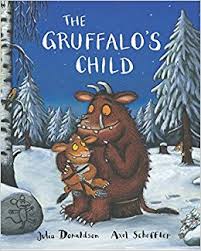 THE GRUFFALO'S CHILD THE GRUFFALO'S CHILDby Julia Donaldson and Axel Scheffler adapted by Tall Stories http://www.tallstories.org.uk/the-gruffalos-child |
 HAIRY MACLARY AND FRIENDS HAIRY MACLARY AND FRIENDSby Lynley Dodd adapted by Nonsense Room http://nonsenseroom.co.uk/wp/hairy-maclary-friends/ |
 HANDA’S SURPRISE HANDA’S SURPRISEby Eileen Browne adapted by Little Angel Theatre https://littleangeltheatre.com/touring/upcoming-tours/ |
 ME MEby Emma Dodd adapted by Little Angel Theatre https://littleangeltheatre.com/touring/upcoming-tours/ |
 THE NIGHT PIRATES THE NIGHT PIRATESby Peter Harris and Deborah Allwright adapted by Nick Brooke http://www.nickbrooke.com/childrens-theatre/the-night-pirates/performance-info |
 PAT-A-CAKE BABY PAT-A-CAKE BABYby Joyce Dunbar and Polly Dunbar adapted by Long Nose Puppets http://www.longnosepuppets.com/tour-dates.html |
 SHARK IN THE PARK SHARK IN THE PARKby Nick Sharrat adapted by Nonsense Room http://nonsenseroom.co.uk/wp/ |
 STICK MAN STICK MANby Julia Donaldson and Axel Scheffler adapted by Scamp Theatre http://www.stickmanlive.com |
 THE TIGER THAT CAME TO TEA THE TIGER THAT CAME TO TEAby Judith Kerr adapted by David Wood http://www.tigerstealive.com/tour/ |
 WHAT THE LADYBIRD HEARD WHAT THE LADYBIRD HEARDby Julia Donaldson and Lydia Monks adapted by Kenny Wax http://www.whattheladybirdheardlive.co.uk |
 WOW SAID THE OWL WOW SAID THE OWLby Tim Hopgood adapted by Little Angel Theatre https://littleangeltheatre.com/whats-on/september-whats-on/wow-said-the-owl/ |
 ZERAFFA GIRAFFA ZERAFFA GIRAFFAby Dianne Hofmeyr and Jane Ray adapted by Little Angel Theatre https://littleangeltheatre.com/whats-on/september-whats-on/zeraffa-giraffa/ |