This blog is no longer being updated and has been replaced by my new blog at jonathanemmett.com/blog

Showing posts with label Pigs Might Fly. Show all posts

Thursday, 31 May 2018

PIGS MIGHT FLY! New Paperback Edition


Around this time last year illustrator Rebecca Harry and I published a set of print-on-demand editions of our Ruby the Duckling books after the original editions went out of print. I'm pleased to announce that Pigs Might Fly!, one of my picture books with illustrator Steve Cox which recently went out of print, has just been re-published in the same format.

The new square-format, print-on-demand edition.

I was particularly keen to get Pigs Might Fly! in print again as it's one of my most popular books to read on school visits and its production is the focus of the How a Picture Book is Made presentation I do with Year 5 and 6 classes.

This slide from my How a Picture Book is Made schools presentation shows some of the character
designs Steve came up with before arriving at the final characters of Waldo, Woody and Wilbur.

The book's popularity with young readers was also demonstrated when it won the “Books for Younger Children” category at the 2006 Red House Children’s Book Awards, a national children's vote awards organised by the Federation of Children’s Book Groups.

Steve and I with my son and daughter and a very shiny trophy
at the 2006 Red House Children’s Book Awards.

The new edition has different page proportions to the original and has been re-typset using open source fonts. One of the advantages of having to re-work the layouts was that it gave us the opportunity to produce a 'directors cut' version of the book which incorporates a few improvements. For example: the original version had no imprints page, so the imprints details were printed on the opening spread. This gave the story a rather awkward start, so we created a new imprints/title spread for the new edition and reworked the opening text to cover both sides of the opening spread.

While the original edition (top) had the imprint details printed on the opening spread,
the new edition (bottom) has the imprints details on a new imprints/title spread.

Most of the other changes were done in response to my experience of reading the book aloud in schools and are less easy to spot. So fans of the book can rest assured that the Big Bad Wolf is just as conniving as he was in the original edition …


… and Wilbur just as indomitable!


Here's what reviewers said about the book when it was originally published.

"A super book with a good storyline, amusingly told and wonderfully illustrated … a book children will want to look at again and again."
BOOKS FOR KEEPS

"Bright, breezy and fun with action on every page."
CAROUSEL

You can find out more about the book on this page of my website and download and print the new Spot the Difference activity sheet by clicking on the image below.


Buy this book at amazon UK Buy at amazon US

Monday, 1 June 2015

Two heads are better than one: The benefits of early author-illustrator collaboration

This post was originally published on Picture Book Den, a blog about picture books by picture book authors and illustrators.


I mentioned in a post earlier this year that, although people often assume that picture book authors and illustrators work closely together, it’s not unusual for the author and illustrator to have no direct contact, with the book’s creation being co-ordinated via the publisher.

One of my Dutch publishers told me that Dutch authors and illustrators regularly get together with the publisher during a picture book’s production to discuss how the project is progressing. However, if my own experience is anything to go by, regular meetings like this are not the norm in the UK. I’d been writing picture books for ten years before a publisher, Puffin, invited me to get together with illustrator Steve Cox to look at some of Steve’s initial concept sketches for our picture book Pigs Might Fly and discuss how it might be illustrated. Before then, I’d only met two illustrators I’d done a book with and spoken to a couple more on the phone, and this was always after the project was completed.

One reason for this lack of direct contact is that many picture book publishers like to moderate all communication between a book's author and illustrator. In the conventional UK set-up, an author gives any comments or ideas they might have regarding the illustrations to an editor, who then (if they agree with them) passes them on to the illustrator (sometimes via the book's designer). This is obviously a rather slow method of communication and and misinterpretations can occur as the message is passed along the chain. Another disadvantage of the conventional set-up is that while the author has some influence over how the book is illustrated, the illustrator has relatively little influence over how the book is written, the story having been largely hammered out before they are on board.

The line of communication between author and illustrator is often indirect.
(Image taken from my "How a book is Made" school presentations)

When I first started creating picture books I'd intended to both write and illustrate and was in the habit of developing ideas simultaneously in both text and illustration. Although my illustration has largely fallen by the wayside, I still think of stories visually as much as verbally. I'll often get a story idea from looking at an image or conceive a story outline as a series of illustrations. So I've always thought that the conventional set-up, with its lack of direct interaction between author and illustrator, is less than ideal. Fortunately, I've been able to team up with several sympathetic illustrators who have been happy to exchange ideas at an early stage and several of my more recent picture books have been developed in a far more collaborative way.

After Mark Oliver had illustrated my text for Tom’s Clockwork Dragon, he and I were both keen to do another picture book together. So rather than leave it to chance, I asked Mark if there was anything he’d particularly like to illustrate. Mark sent me a list of ideas, one of which – a mechanical monster manual – became Monsters: An Owner’s Guide. We developed the idea between us and when we had a draft of the text and some concept art that we were both happy with, we offered it as a joint project to publishers. Thankfully, Macmillan accepted it and subsequently took Aliens: An Owner’s Guide as a follow-up.

Some of Mark Oliver's early concept art for Monsters: An Owner's Guide

Since then, I’ve worked on several stories where the illustrator has been involved from the initial concept stage and has often provided the initial inspiration. The Treasure of Captain Claw was written in answer to Steve Cox’s wish to illustrate a submarine story and my latest picture book, The Silver Serpent Cup, was written in response to a set of outlandish vehicle models that Ed Eaves had offered as a possible source of inspiration. 

The Silver Serpent Cup and some of the outlandish vehicle models, made by Ed Eaves, that inspired it.

Not all of the author-illustrator collaborations I’ve worked on have made it into print – I wrote two unpublished stories with the late Vanessa Cabban – but I’ve always enjoyed working with the illustrator to create them. And I suspect that, having helped shape the initial concept, the illustrators I’ve created these books with have felt a little more attached to these projects and may have been prepared to lavish a little extra care and attention on them.

Some of Vanessa Cabban's "Clara and Bertie" character sketches from an unpublished project we developed together.

There’s a synergy when text and illustration work well together in a picture book. This happens naturally when the same person is both writing and illustrating, but if the author and illustrator are two different people, such a synergy can be a lot easier to achieve if they get together early on to exchange ideas. I’d certainly recommend it!


My latest collaborative picture book is The Silver Serpent Cup illustrated by Ed Eaves and published by Oxford University Press.


Friday, 27 March 2015

Drawing the anthropomorphic line: how human should your characters be?

This post was originally published on Picture Book Den, a blog about picture books by picture book authors and illustrators.


Drawing the anthropomorphic line 

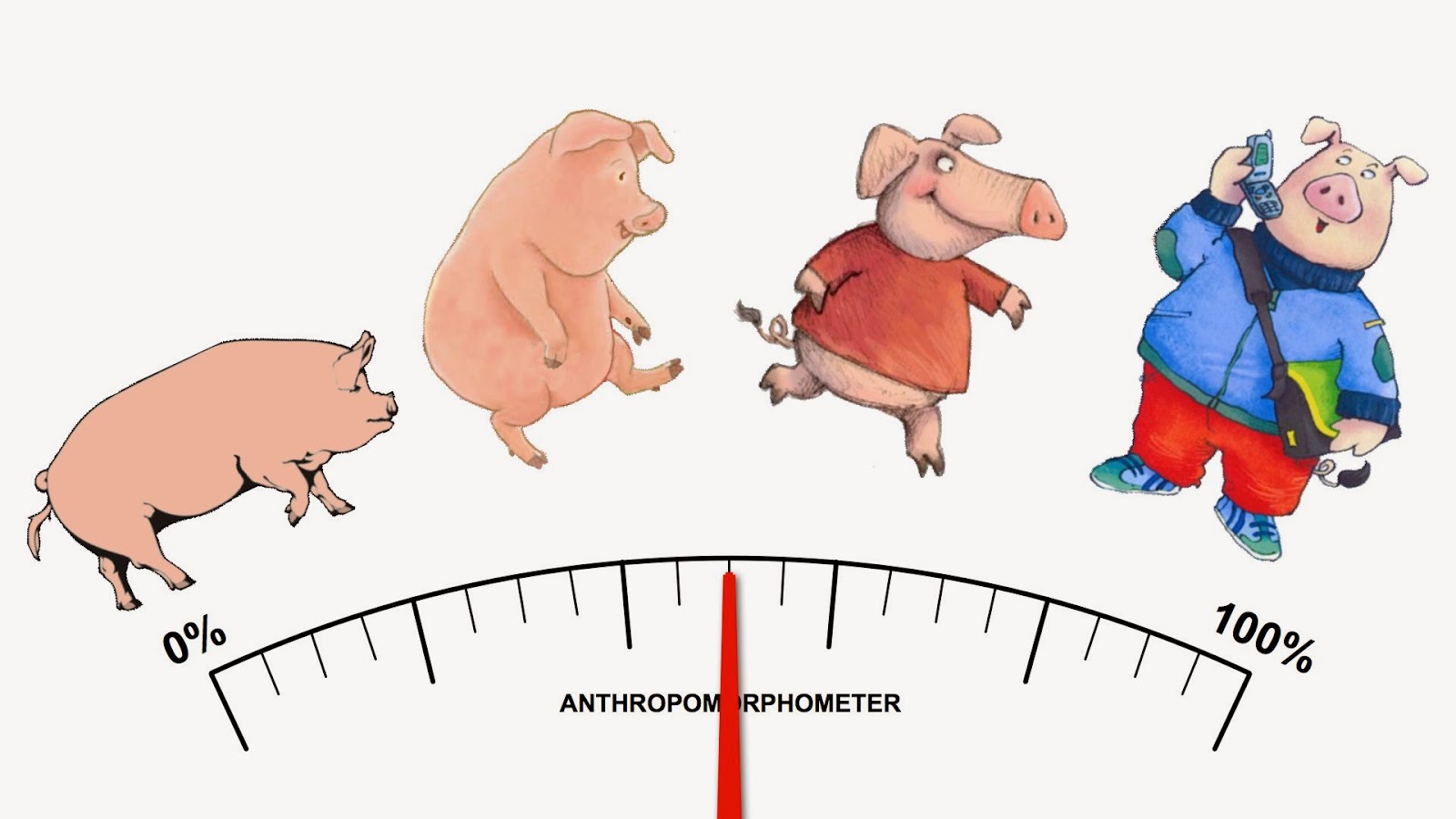
The “Pig Tales” session I often do on my school and library visits features three picture books I’ve written about pigs. In between reading the three stories I explain that one of the things that makes them different from each other is how much anthropomorphism they use. I explain what this ridiculously long word means and why it’s such a useful tool for storytellers.


The dictionary definition of anthropomorphism is “the attribution of human characteristics or behaviour to a god, animal, or object.” I tell the children that anthropomorphism is simply “making something more like a person.”

Many of mankind’s oldest stories come from Africa, the birthplace of the human race. In the African stories of Anansi the spider, Anansi thinks and speaks like a human and in some of the stories he takes on human form.

Anansi the Spider: A Tale from the Ashanti by Gerald McDermott

Storytellers have been using anthropomorphism – making animals think, talk and look like humans – ever since.

Lucy Cousins's Maisy Mouse

And it’s not just animals – you can anthropomorphise almost anything … 


… vegetables …


… vehicles …


… even household appliances!

One reason storytellers use anthropomorphism is because people usually find characters more appealing if they think they are like them. Anthropomorphising an animal or even a toaster makes us care about what happens to them.

Anthropomorphism is not an either-or option; you can vary the amount you use. And, if you are creating a picture book, it’s worth taking the time to get the balance just right in both text and illustrations.

You can use varying amounts of anthropomorphism

My picture book story Pigs Might Fly is a sequel to the traditional tale of The Three Little Pigs. The pigs in my story build and fly aeroplanes, so they are fully anthropomorphic – the story could just as well be about three humans. This was reflected in some of illustrator Steve Cox’s first character sketches for the book, where the pigs are fully clothed and one of them is carrying a phone and a laptop. However, the publisher felt that these characters didn’t have quite the right appeal, and the character designs that eventually appeared in the book wore less clothing and were more recognisably pig-like.

Some of Steve Cox's character sketches for Pigs Might Fly:
Early, fully-anthropomorphic characters on the left and final characters on the right.

The pig in The Pig’s Knickers lives outdoors on a farm and – before the events of the story – would not usually wear clothing. However I made him talk, think and feel like a human in the text and Vanessa Cabban’s illustrations show him dancing on his hind legs and picking things up with his front trotters. As such, he’s a good example of a semi-anthropomorphic character.

One of Vanessa Cabban's illustrations for The Pig's Knickers

The Princess and the Pig is the story of a piglet that gets switched at birth and is brought up as a princess in the mistaken belief that she has been bewitched. The running joke in the story is that, while the reader knows that Princess Priscilla is nothing more than an ordinary pig, the characters in the story don’t and spend all their time trying to make her look and behave like a human. When I first started thinking about the story I considered making Priscilla a little anthropomorphic, but in the end I decided that the story would be much funnier if I didn’t anthropomorphise her at all.

One of Poly Bernatene's spreads for The Princess and the Pig

So the next time you’re writing a story with animal* characters, take a moment to think about where’s the best place to draw your anthropomorphic line!


*Or vegetables or vehicles or household appliances!


My latest semi-anthropomorphic picture book is A Spot of Bother illustrated by Vanessa Cabban and published by Walker Books.


find your local bookshopBuy this book at amazon UKBuy at amazon US