This blog is no longer being updated and has been replaced by my new blog at jonathanemmett.com/blog

Wednesday, 13 May 2015

THE SILVER SERPENT CUP Top Trumps card game and colouring sheets


To mark the publication of Fast and Furry Racers: The Silver Serpent Cup, I’ve created a Top Trumps style card game featuring all twenty-four of the vehicles from the book.


You can download the full set of cards along with a rules envelope to store them in HERE.


In the last post I mentioned how impressed I was with Ed Eave’s vehicle design sketches when I first saw them. Ed has kindly agreed to make these available as a set of colouring sheets which you can download HERE.


Find out more about The Silver Serpent Cup on my web site


find your local bookshopBuy this book at amazon UKBuy at amazon US 

Thursday, 7 May 2015

The Silver Serpent Cup • New Paperback


I have a new paperback picture book coming out today! Fast and Furry Racers: The Silver Serpent Cup is illustrated by Ed Eaves and published by Oxford University Press. It's a high-speed, adrenaline-fuelled rhyming romp of a story that we hope will be the first of a series of Fast and Furry Racers books.

Today the town of Furryville’s a very noisy place,
Crammed with crowds of creatures getting ready for a race.
The air is filled with honking horns and engines revving up,
As racers take their places for THE SILVER SERPENT CUP!

The initial inspiration for book came from illustrator Ed Eaves. Ed and I had previously done a couple of pop-up books together. We’d got on well and were hoping to work together again some time. About a year after we’d finished the second pop-up book, Ed sent me some photos of a set of cardboard models that he’d made for his illustration degree over a decade earlier. The models were of animals driving outrageously souped-up cars and planes, many of which were armed with enormous weapons. Ed had thought about doing a picture book along similar lines, but hadn’t been able to come up with a suitable story, so he’d sent them to me to see if they would “spark an idea.”

Some of the vehicle models that Ed Eaves made for his illustration degree show.

I found the models very appealing and an idea for a no-holds-barred race story, featuring a motley assortment of creatures and vehicles immediately sprang into my mind. However, I couldn’t get the story to work straight away and was tinkering with it, off and on, for more than a year before I went back to Ed with a draft. Most of Ed’s models were of aeroplanes and having already written a picture book about an air race, Pigs Might Fly, I decided that the race in this story needed to be distinctly different. So I extended the range of vehicles to include cars, boats, submarines, a steam train and a tunnelling machine. I’m always arguing that we need more picture books that can match the appeal of children’s TV, film and video games and one of the biggest inspirations for the story was the Wacky Races cartoon series which was a childhood favourite of mine. Another more contemporary influence was the Mario Kart video games. My kids love playing these and I wanted to see if we could create a similar sense of action-packed, adrenaline-fuelled excitement in a picture book. In Mario Kart, racers fire a variety of bullets, bombs and shells to sabotage other vehicles. I borrowed this idea for a scene towards the end of the book where villainous alligator Al McNasty tries to win the race by firing rockets at the other racers’ vehicles.

Ed and I wanted the book to have a similar appeal to TV show Wacky Races (left) and video game Mario Kart (right).

Luckily Ed liked the draft I sent him, so we sent it out to publishers, along with the photos of Ed’s models. We were delighted when Peter Marley at Oxford University Press accepted it!

Only seven of the racers are directly referred to in the story, but the text makes it clear that a lot more are taking part in the race. Ed decided that there would be twenty four vehicles in all and designed all of them before he began work on the illustrations. I was blown away by these design sketches when I first saw them. Each of the vehicles looks distinctly different, partly because Ed made many of them look like the animals that drove them. You can see that Ed’s given a lot of thought to the design of each and every one of them.

Ed designed many of the vehicles to look like their drivers.


All twenty four vehicles lined up on the starting grid. 

Ed illustrations also draw on Wacky Races and Mario Kart for inspiration and this really comes across in his action-packed, dynamic final artwork. This submarine spread where octopus Ollie Octllini takes the lead among the underwater racers, is one of my favourites.


Here's a trailer I made for the book.


As you can probably tell, this book has been a pleasure to work on. I only hope children will enjoy reading it as much as Ed and I enjoyed making it!

Visit The Silver Serpent Cup's page on my web site


find your local bookshopBuy this book at amazon UKBuy at amazon US

Monday, 27 April 2015

Why I’ll still be voting Green, despite their crazy copyright policy.

I don’t usually use this blog to make political statements, but as a Green Party supporter I’m concerned by the way the party has been criticised and attacked by many other authors and illustrators on blogs and social media in the last few days and wanted to show that not all authors and illustrators regard the Green Party as “morons”.

The furore is over the Green party’s current policies on copyright, as outlined on their policies website. The proposal that’s created the biggest fuss is the reduction of copyright to 14 years. Whether this is 14 years after creation or 14 years after the creator’s death is the subject of some disagreement. The proposal to legalise peer-to-peer sharing has attracted less outrage, but seems every bit as problematic.

As a full-time author whose living is dependent on copyright, I’m not going to attempt to defend these policies. I think they show a lack of understanding of how many people working in the creative industries actually earn a living and appear to be a triumph of ideology over common sense.

I’m not a Green Party member and, although I have voted for them in the past, I’ve only done so intermittently, partly because of impractical policies like these. However, like any political party, the Green Party’s policies are subject to constant revision and over the last few years, as the party has grown bigger, I've noticed that such unrealistic policies are increasingly being supplanted by more pragmatic, properly thought through alternatives. Some Green Party members, including the MP Caroline Lucas, appear to have got the message that their current copyright policy is unsuitable and this morning the party announced that that it will be reviewing the policy at its next conference. However, this will not be until after the general election, which may be too late for some of the authors and illustrators who have said that they were thinking of voting Green but, because of the copyright policy, will now be voting for another party.

I will still be voting Green. Copyright is important to me, but there are far more important issues at stake in this election. And if the election results in a hung parliament and the Greens gain enough seats to have some influence over government policy, I don’t believe that revising copyright will be one of their top priorities.

I think it’s reasonable to assume that one of the Greens’ top priorities will be addressing climate change. This is just as well as, while the Greens may currently be inept on copyright, the last 20 years of government has clearly demonstrated that the other UK parties are inept on tackling climate change. And climate change is THE single most important issue facing our generation. Hundreds of thousands of lives have already been lost as a result of our failure to address it effectively and things will get far worse if our politicians continue to downplay its importance. Here’s how environmental organisation Greenpeace outlines the enormity of the problem.
Glaciers, permafrost and sea ice are disappearing. Sea levels are rising, coral reefs dying, seasons changing and extreme weather events becoming more common. The impacts of climate change are already responsible for killing an estimated 315,000 people every year and damaging ecosystems. And this is just the beginning - the science predicts that anything more than 2°C rise in global temperatures puts us on the road to potentially catastrophic problems. There will be more flooding, more drought, more disease, more famine and more war, creating hundreds of millions of refugees and causing the destruction of entire ecosystems and species.
While issues such as the NHS, the economy, education or the benefits system are important, in 50 years time our failure to tackle any of these effectively will seem trivial in contrast to our failure to tackle the threats posed by climate change. If we don’t get our act together soon, future generations will wonder how our generation could be so astonishingly short-sighted and selfish.

Authors and illustrators tend to be relatively left-wing in their views, so I assume that most of those authors and illustrators who have decided to switch their vote away from the Greens are planning to vote Labour instead. Unfortunately the Green party’s crazy copyright policy is more than matched by some of Labour’s crazy policies on climate change, such as those relating to the aviation industry.

This is what Greenpeace had to say about the last Labour government’s stance on aviation in its Blair and Climate Change – The Rhetoric-Reality Gap report of 2005.
The Government’s denial of the urgent need to tackle climate-changing pollution from aviation is probably the greatest failure of all. According to the Sustainable Development Commission, the growth in emissions from air travel threatens to negate any reductions made on the ground.
Currently aviation emissions account for 11% of the UK total. Aviation emissions will account for 25% of the UK total by 2030 – this will rise to 33% by 2050. The Government’s decision to commit to airport expansion, against Royal Commission advice, demonstrates an utter lack of consistency with its commitments to tackling climate change and an inability to take the real steps needed to address the problem.
The Labour party leadership’s extraordinary naivety regarding the effects of aviation growth were highlighted in a 2007 interview with Tony Blair in which the then Prime Minister admitted that he would be reluctant to give up his frequent holidays abroad to help tackle climate change. Blair went on to say that encouraging people to holiday nearer to home was “impractical” and suggested that we ought to look at making air travel more energy efficient instead. A chorus of engineering and transport experts subsequently made it clear how "impractical" Blair's own suggestion was, explaining that even if energy efficient airliners were to be developed immediately, it would be 20 years before they had any impact on the industry. Only 5% of the world’s population have ever flown on an aeroplane. Effectively Blair was arguing that maintaining the lifestyle of a relatively affluent, privileged minority was more important than saving the planet for future generations.

Labour's policies on aviation are as ill-conceived as the Greens'
policies on copyright, but have far more damaging consequences.
Despite climate scientists' increasingly urgent calls for tougher restrictions on carbon emissions, the Labour party continues to doggedly support airport expansion. The 2010 Labour manifesto supported the construction of a third runway at Heathrow – a move that was opposed by the Greens, the Lib Dems and even the Tories on environmental grounds. The 2015 Labour manifesto refers to a “need for growth” in UK airport capacity and the party’s current leader, Ed Miliband, has dismissed sanctions to curb aviation growth, saying that it would be wrong to impose targets on airlines.

Claiming that you're committed to tackling climate change, but are not prepared to tackle aviation is like saying you're committed to vegetarianism, but are not prepared to give up your weekly hog roast. One person’s transatlantic flight adds as much to their carbon footprint as a typical year's worth of driving. Unfortunately, studies have shown that UK air passengers are unlikely to change their flying habits unless they are made to do so. And, if we have a majority Labour government after the next election, it’s clear that this is not going to happen any time soon.

Despite their deeply misguided stance on aviation and climate change, I don’t think the Labour Party are "morons". I think they have got their aviation and climate change policy badly wrong, just as I think that the Green Party have got their copyright policy badly wrong. However the consequences of Labour’s ineptness on climate change will be far more devastating, which is one of the reasons I will be voting Green rather than Labour next month.

Another reason I’ll be voting Green is that policy comparison websites such as Vote for Polices and Verto have told me that the Green Party’s policies across a wide range of areas are more in keeping with my own views than those of the other parties. I’m a supporter of the Fair Admissions campaign which aims to end religious discrimination of students and staff in UK state-funded schools. While the Greens and the Lib Dems support the campaign, Labour and the Tories do not, so this is another area where I think these other parties have got their policies badly wrong.

So that’s why – despite a crazy copyright policy that’s clearly not in my personal interests – I’ll still be voting Green. I hope that other authors and illustrators who are concerned about climate change will be able to see the bigger picture and consider doing the same.


Tuesday, 21 April 2015

The Silver Serpent Cup • Round Hill School Edition


The Silver Serpent Cup illustrated by Ed Eaves and the Round Hill School Edition.

I have a new picture book coming out next month called The Silver Serpent Cup. The version you can buy in the shops is illustrated by Ed Eaves who also provided the initial inspiration for the story (more about that in a future post). However this post is about another very special version of the book that was illustrated by the children of Round Hill Primary School.

Round Hill is my local primary school and both of my children went to it. Last year Gina Bore, the school's literacy co-ordinator, got in touch to ask if I would get involved with the school’s book week. We talked through a several ideas and the one that took Gina’s fancy was based on a day-long illustration workshop I occasionally do in schools. In the standard workshop, I spend the whole day working with a single class. At the beginning of the day, I present the children with a picture book text. Then I teach the children some of the principles of character design and illustration and they spend the day producing a class version of the book, with each child illustrating an individual spread. I use texts for picture books that are currently in production, but have not yet been published to avoid the children having any preconceptions about how the finished book should look. At the end of the day, I show the children roughs or final artwork that the real illustrator has produced for the actual book.

Gina wondered if we could extend this activity over a whole week and have the whole school (more than 400 children) illustrating the book. I wasn’t sure how well this would work, but I said I’d be happy to give it a go. In the end, it worked brilliantly!

The book week was in February. I introduced the project to the whole school in an assembly on Monday morning, read them the text and gave them a few very basic tips about book illustration such as “Beware of the gutter!” Then I spent some extra time with the year 6 classes giving them some more in-depth advice. Every child in the school produced a spread, endpaper or cover design. Each teacher selected a complete set of illustrations from their class to make their individual class edition, so we ended up with 12 different editions of the book. I then chose at least one spread from each class edition to go into an overall Round Hill School edition.

This was quite a Herculean task, so when I went in to collect the class editions, I wasn’t sure what I would find. Fortunately the whole school had got behind the project. The children were buzzing about it in the corridors and Gina had a stack of impressive class editions for me to take home.

The school had already whittled down the illustrations into 12 class editions, which left me with about 200 spreads to choose the school edition from.

A set of illustrations for 6H's class edition

It was a tough job selecting the spreads for the overall school edition and I had to leave out lots of excellent illustrations. I was really impressed with the original way in which many children had chosen to interpret the story. And the children who had been working on the book’s cover had written some really appealing blurb to go on the back. Eventually I settled upon a final selection which I bound together to make the school edition.

The Round Hill School edition

Here are some of the spreads from the school edition, with Ed’s illustrations for the regular edition shown beneath them.

Lauren's cover had a lovely detailed drawing of Mole's tunnelling machine on the front
and some very engaging blurb for the back.
Jack's illustration style for this train spread reminded me of David Tazzyman who illustrates the Mister Gum books
Rabbits class used eye-catching collage for all their spreads, including this one by William.

We wound up the week with an assembly on the Friday afternoon, just before the school broke up for half term. After showing the children the illustrations I’d chosen for their school edition, I showed them the illustrations that Ed Eaves had done for the actual book. The children were really impressed by these and were able to appreciate Ed’s artwork all the more having spent some time creating their own versions.

Here's me revealing the illustrations I'd chosen for the school edition …

I’d explained at the beginning of the week that we would choose one spread from the school edition as an overall winner and that the spread’s illustrator would win a copy of the actual book, signed by me and Ed, along with a dedication in one of my future books. I’d decided that, as the book’s illustrator, Ed was much better qualified to make this decision than I was and he announced the winner via a live FaceTime video connection during the assembly. 

… and here's Ed announcing the overall winner via FaceTime

The spread Ed chose was this endpaper, showing all the different vehicles. It was a collaborative effort by Otter Class, so we awarded the prize to the whole class.

The winning spread was this endpaper created by Otter Class

The project would have worked nearly so well if the whole school had not got behind it so enthusiastically, so I’d like to say a big THANK YOU to all the young illustrators, their teachers and TAs and Gina who did such a terrific job of co-ordinating the project in the school.


The Silver Serpent Cup is published next week by Oxford University Press.

Click here to find out more about the book.


Buy this book at amazon UK Buy at amazon US 

Tuesday, 7 April 2015

Derbyshire Literature Festival events – Clay Cross & Dronfield Libraries, Sat 16 May 2015

If you live near Clay Cross or Dronfield Libraries in Derbyshire you might like to come along to one of my free events for this year's Derbyshire Literature Festival. I'll be reading my new picture book The Clockwork Dragon, illustrated by Elys Dolan, explaining how the story came about and we'll be making some 3D dragon masks.
Here's a quick description of the story:
The Kingdom of Rodney is being terrorised by Flamethrottle the dragon. Fortunately Max, a young toymaker, and Lizzie, an armourer, are more than a match for this man-eating monster and the two of them come up with a clever plan to drive it away.
Here's a trailer for the book:


And here's me wearing one the dragon masks we'll be making. Come along to one of the events and you too could look just as handsome as this!


The events are suitable for children aged four to eight.

TICKETS ARE FREE and can be booked at any Derbyshire library or online using the links below. 

EVENT DETAILS

Saturday 16th May
Clay Cross Library 
10.30 am - 11.30 am

Holmgate Road, Chesterfield, Derbyshire S45 9PH

CLICK HERE TO BOOK TICKETS FOR THIS EVENT


Saturday 16th May
Dronfield Library 
1.30 pm – 2.30 pm

Manor House, High Street, Dronfield S18 1PY

CLICK HERE TO BOOK TICKETS FOR THIS EVENT


Visit my website to find out more about the book


Friday, 27 March 2015

Drawing the anthropomorphic line: how human should your characters be?

This post was originally published on Picture Book Den, a blog about picture books by picture book authors and illustrators.


Drawing the anthropomorphic line 

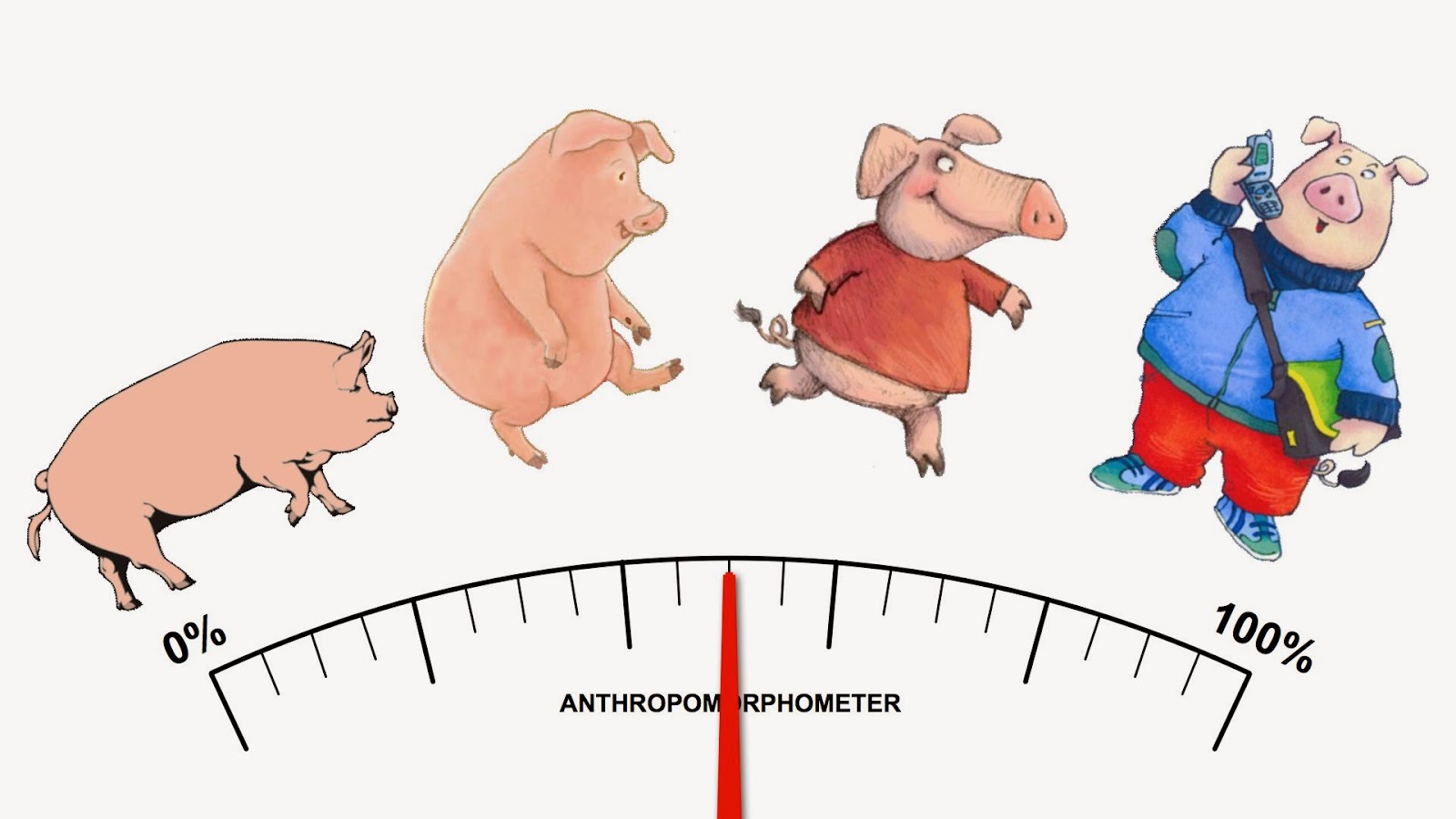
The “Pig Tales” session I often do on my school and library visits features three picture books I’ve written about pigs. In between reading the three stories I explain that one of the things that makes them different from each other is how much anthropomorphism they use. I explain what this ridiculously long word means and why it’s such a useful tool for storytellers.


The dictionary definition of anthropomorphism is “the attribution of human characteristics or behaviour to a god, animal, or object.” I tell the children that anthropomorphism is simply “making something more like a person.”

Many of mankind’s oldest stories come from Africa, the birthplace of the human race. In the African stories of Anansi the spider, Anansi thinks and speaks like a human and in some of the stories he takes on human form.

Anansi the Spider: A Tale from the Ashanti by Gerald McDermott

Storytellers have been using anthropomorphism – making animals think, talk and look like humans – ever since.

Lucy Cousins's Maisy Mouse

And it’s not just animals – you can anthropomorphise almost anything … 


… vegetables …


… vehicles …


… even household appliances!

One reason storytellers use anthropomorphism is because people usually find characters more appealing if they think they are like them. Anthropomorphising an animal or even a toaster makes us care about what happens to them.

Anthropomorphism is not an either-or option; you can vary the amount you use. And, if you are creating a picture book, it’s worth taking the time to get the balance just right in both text and illustrations.

You can use varying amounts of anthropomorphism

My picture book story Pigs Might Fly is a sequel to the traditional tale of The Three Little Pigs. The pigs in my story build and fly aeroplanes, so they are fully anthropomorphic – the story could just as well be about three humans. This was reflected in some of illustrator Steve Cox’s first character sketches for the book, where the pigs are fully clothed and one of them is carrying a phone and a laptop. However, the publisher felt that these characters didn’t have quite the right appeal, and the character designs that eventually appeared in the book wore less clothing and were more recognisably pig-like.

Some of Steve Cox's character sketches for Pigs Might Fly:
Early, fully-anthropomorphic characters on the left and final characters on the right.

The pig in The Pig’s Knickers lives outdoors on a farm and – before the events of the story – would not usually wear clothing. However I made him talk, think and feel like a human in the text and Vanessa Cabban’s illustrations show him dancing on his hind legs and picking things up with his front trotters. As such, he’s a good example of a semi-anthropomorphic character.

One of Vanessa Cabban's illustrations for The Pig's Knickers

The Princess and the Pig is the story of a piglet that gets switched at birth and is brought up as a princess in the mistaken belief that she has been bewitched. The running joke in the story is that, while the reader knows that Princess Priscilla is nothing more than an ordinary pig, the characters in the story don’t and spend all their time trying to make her look and behave like a human. When I first started thinking about the story I considered making Priscilla a little anthropomorphic, but in the end I decided that the story would be much funnier if I didn’t anthropomorphise her at all.

One of Poly Bernatene's spreads for The Princess and the Pig

So the next time you’re writing a story with animal* characters, take a moment to think about where’s the best place to draw your anthropomorphic line!


*Or vegetables or vehicles or household appliances!


My latest semi-anthropomorphic picture book is A Spot of Bother illustrated by Vanessa Cabban and published by Walker Books.


find your local bookshopBuy this book at amazon UKBuy at amazon US