This blog is no longer being updated and has been replaced by my new blog at jonathanemmett.com/blog

Saturday, 12 September 2015

HERE BE MONSTERS & THE SANTA TRAP rehearsals (UPDATED)

Following on from my last post, I popped down to the Theatre Royal, Winchester this week to spend an afternoon at the rehearsals of the Mayflower Productions' new Here Be Monsters and Santa Trap stage shows.

The Here Be Monsters show opens at the Theatre Royal,
Winchester  on the Saturday 19th September 2015 

Although the two shows are being created side by side, The Santa Trap opens a couple of months after Here Be Monsters, so it was not as far ahead in terms of rehearsals, but I saw the company run through the first half of the script including a couple of Simon Slater's songs.

Despotic brat Bradley Bartleby is played by Toby Vaughan. I don't know what sort of a child Toby was, but he did a worryingly convincing job of stomping around the stage, throwing tantrums, while the rest of the cast quivered and cowered on cue. There are only three main characters in the book – Bradley and his parents – but writer and director Robin Belfield has extended the cast for the musical by expanding the roles of the three secretaries (Robin christened them Scribble, Scribe and Smythe) who are hired to type up Bradley's Christmas list.

The three secretaries, who only appear on one page of the
book, get a bigger role in the play.

After lunch I saw a complete run though of the Here Be Monsters show. The music for both of the shows is performed live on stage by the cast but the two scores are played on different instruments. While The Santa Trap score includes a baritone sax and electronic piano, the music for Here Be Monsters includes an accordion, banjo and cajón and is more folky in style (composer and musical director Simon Slater aptly described some of the songs as having a Mumford & Sons feel). The Setting Sail song that the pirates sing on their way to the mysterious island is so catchy, by the third time I'd heard it, it was a struggle not to start singing along – but I decided to leave it to the professionals. You can watch the cast rehearsing it, and hear Eloise Secker (AKA Sneaky McSqueaky) tell you more about the show in the video below.

A few words from Sneaky McSqueaky (aka Eloise Secker) on the brand new musical from Mayflower Productions and Belfield & Slater Musicals, Here Be Monsters.See Here Be Monsters in Winchester 19 & 20 September.
Posted by Theatre Royal Winchester on Monday, 14 September 2015


The talented cast play the score as well as the characters (Photo: Marco Piras) 

While the cast of The Santa Trap is bigger than that of the book, the cast of Here Be Monsters is slightly smaller. Crew members Blue-Bottomed Bart and Dead-Eyed Dirk (the baboon and crocodile in the book) have had to walk the plank, but all of the other crew members are still on board for the musical. The fearsome Captain Cut-Throat is played by Ben Tolley whose accordion playing gives the show a properly piratey atmosphere.

Ben Tolley plays the villainous Captain Cut-Throat. (Photo: Marco Piras) 

Producer and production designer Rachel Fox was also at the rehearsal and showed me some of her set designs for the shows. Like most touring shows, the sets are designed to be taken apart easily so that they will pack into the back of a large van, but the sets for these shows are especially ingenious as they are double-sided. So the pieces of The Santa Trap set that show the interior of Bartleby Hall can be turned around and reassembled to show the deck of Captain Cut-Throat's pirate ship. This will be particularly useful for venues like the Mayflower Theatre in Southampton, where both shows will be performed on the same stage on the same day.

The sets were still being built when I saw the rehearsals, as were some of Marc Parrett's monster puppets, but I did get a sneak preview of the kraken's tentacle …

Exit, pursued by a tentacle: My rather blurry photo of  Sneaky McSqueaky (Eloise Secker) being snatched by the kraken.

… and a couple of the costumes for the Here Be Monsters show as Lauren and Elouise tried them on for the first time.

Lauren Storer tries on her Quilly Von Squint crow costume for the first time.


I always have a sense of trepidation when one of my stories is adapted for another medium, but I needn't have worried in this instance. Robin and Simon have created two smashing shows and I was hugely impressed by the talented cast and crew who have done a great job of bringing the characters and settings to life. I can't wait to see the finished shows!

Here I am with the cast and and crew.
From left: Robin Belfield (writer & director), Adam Stewart (technical stage manager), Toby Vaughan (Stinky & Bradley), Lauren Storer (Quilly, Mrs Bartleby & Scribble), Ben Tolley (Captain Cut-Throat & Mr Bartleby), Rachel Reeve (company stage manager), me, Eloise Secker (Sneaky & Scribe) and Josh Sneesby (Findus & Smythe).
(Photo: Marco Piras) 

And here's Robin and me with composer and musical director Simon Slater. (Photo: Marco Piras) 


Here Be Monsters premieres at the Theatre Royal, Winchester on 19 September 2015 before going on to another 8 venues in October & November with further dates to be announced.


The Santa Trap premieres at the Mayflower Theatre, Southampton on 15 November 2015 and then does a couple of days at The Plough Arts Centre, Torrington, before its main run at the New Theatre Royal, Portsmouth from 19 December to 3 January 2016.


Wednesday, 2 September 2015

THE SANTA TRAP and HERE BE MONSTERS stage shows

I’m thrilled to announce that two of the picture books written by me and illustrated by Poly Bernatene are being adapted into stage shows by Belfield & Slater for Mayflower Productions.


Theatre director Robin Belfield first got in touch with me five years ago to say that he was interested in adapting the The Santa Trap for the stage, having read the book to his young daughter. Robin wasn't able to get the project off the ground at that time, but last year he came back to me with a proposal for a musical stage show in collaboration with composer Simon Slater.

The show is being produced by Mayflower Productions, a newly created-subsidiary of the Mayflower Theatre in Southampton, set up to create touring shows. The Santa Trap is obviously a Christmas show with a seasonal appeal, which is why – to my great delight – the same team are also creating a Here Be Monsters show to be performed by the same cast for the rest of the year.

Rehearsals started last week in Southampton and, since my family and I happened to be in the area, we dropped in to meet the cast and crew.

Here I am with the cast, crew and producers of the shows

It was only the second day of rehearsals, so they were just trying out the scripts and experimenting with some prototype puppets and props.

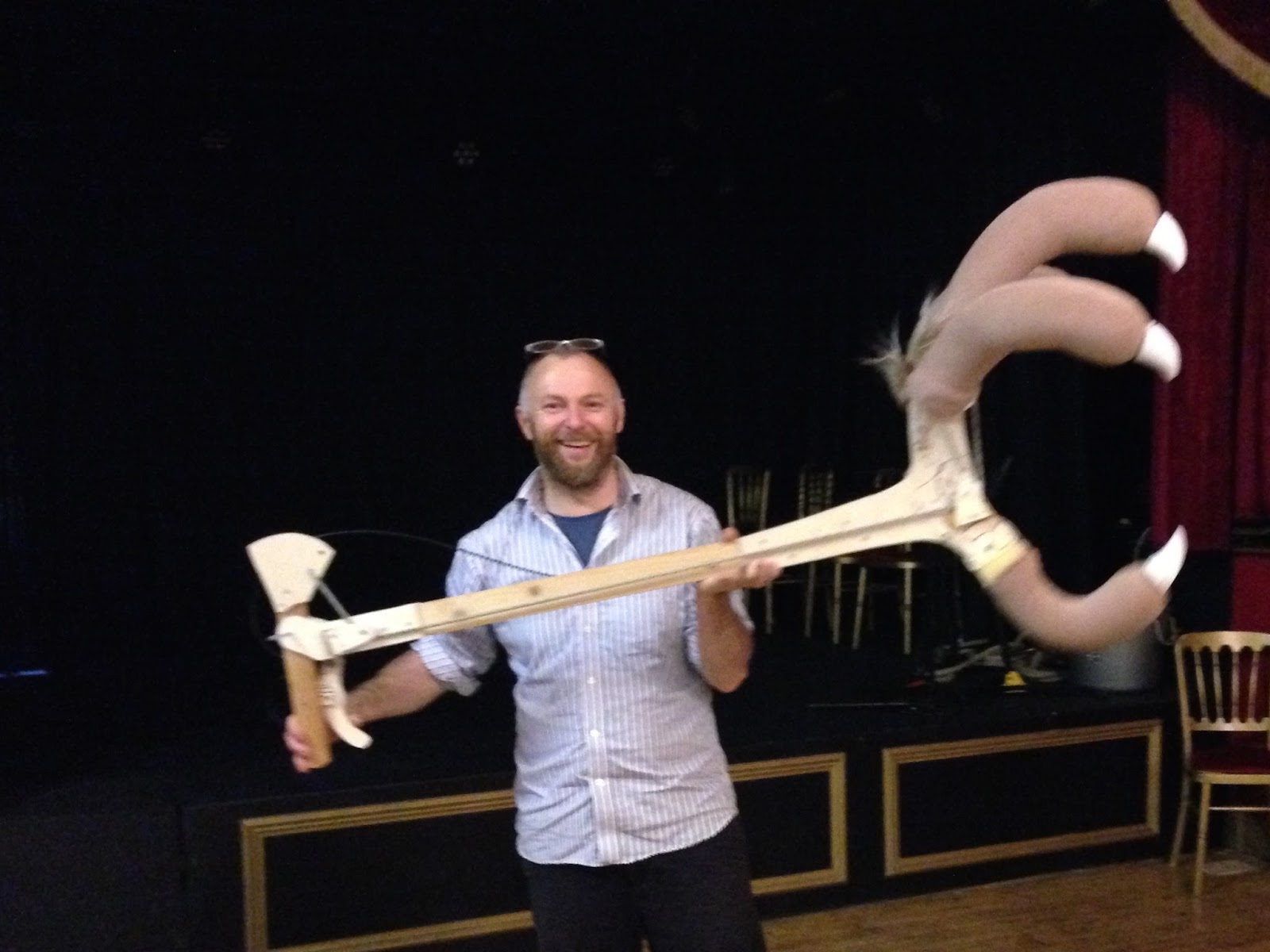
Puppet-maker Marc Parrett gets to grips with his giant claw. 

Cast member Lauren Storer with one of the “cracking” baby monster prototype puppets.
(Sadly, the legs, kindly provided by producer/designer Rachel Fox for this photo,
won't feature in the finished puppet. )

This prehensile prototype prop will double up as both a kraken’s tentacle in Here Be Monsters
and an elephant’s trunk in The Santa Trap.

They seemed like a lovely, enthusiastic group of people and I’m really looking forward to seeing how they bring brattish Bradley and Captain Cut-Throat’s villainous crew to life.


Here Be Monsters premieres at the Theatre Royal, Winchester on 19 September 2015 before going on to another 8 venues in October & November.  Most of the 2015 venues are in the south of England, but there are plans to tour the show further afield in spring and autumn next year.

Click here to go to the Mayflower Productions website for the Here Be Monsters tour dates and booking links.


The Santa Trap premieres at the Mayflower Theatre, Southampton on 15 November 2015 and then does a couple of days at The Plough Arts Centre, Torrington, before its main run at the New Theatre Royal, Portsmouth from 19 December to 3 January 2016.

Click here to go to the Mayflower Productions website for The Santa Trap dates and booking links.


I’ll be visiting the company again next week, so watch this space for an update on their progress.


Thursday, 27 August 2015

The Emperor's New Clones • Early Reader

I have a new early reader book coming out today!

The Emperor's New Clones is illustrated by Martin Chatterton  and is the second book Martin and I have done together for Egmont's Bananas early reader series, the first being Danny Dreadnought Saves the World.

The idea for book came to me when I was thinking up ideas for another book, Skyboy and other Stupendous Science Stories. As the title suggests, that book contains a collection of stories with a science theme, so I began by writing out a list of scientific fields and then tried to come up with a story idea to go with each of them. One of the fields on my list was “Genetics and Cloning”. As soon as I thought about clones, the punning title “The Emperor’s New Clones” popped into my head and I came up with idea of Robbie Remus, the reluctant boy Emperor, to fit it.

In the end, I didn’t use that story in the Skyboy collection, but I expanded the outline and offered it to Egmont for their Bananas series. Series editor Hanna Sandford liked the idea, so I wrote it up as a story and, a couple of drafts later, Egmont agreed to take it. 

One thing that was missing from the early drafts is the blasterball match at the beginning of the book. Blasterball is a futuristic sport, played in zero-gravity, in which two teams score points by firing a ball into the opposing team's black hole. Robbie is passionate about the sport, but has to give up playing it when he becomes Galactic Emperor. However he’s able to take it up again thanks to Professor Parton and his Duplitron cloning machine. Although Robbie’s love of blasterball was described in the first draft, I’d neglected to show him actually playing it. Following the classic writing rule of “show, don’t tell”, Hannah pointed out that the story would work better if we showed the reader what Robbie was missing out on. So I wrote a new opening scene that drops the reader straight into the closing minutes of a blasterball match. 

The book starts with a blasterball match. I love the "pigtail grommets" Martin drew in the girl's helmet in the foreground.

I give a lot of thought to character names and occasionally use them to sneak in little in-jokes or references that some older readers might possibly pick up on. There are a couple in this story. Miss Sourdust, the overly officious Imperial Assistant is named after Sourdust, the similarly officious Master of Ritual in Mervyn Peake’s magnificent Gormenghast books. The second reference is even more tenuous and geeky; cloning genius Professor Parton is named after Dolly Parton the country singer, who also gave her name to Dolly the sheep (the first animal to be successfully cloned from another adult).

Professor Parton (left) is named after Dolly Parton (middle), who also gave her name to Dolly the cloned sheep (right).

I really liked Martin Chatterton's illustrations for our first Banana book, Danny Dreadnought Saves the World and Martin’s energetic comic-strip-like style is a great fit for this story too. He’s really captured the excitement of the Blasterball game (see spread above) and I love the zany-looking cast of multi-species characters he’s created. 

Martin Chatterton's illustrations include some weird and wonderful alien characters.

Here's a trailer for the book.


The cloned versions of Robbie are practically identical. See if you can tell them apart on this activity sheet.
Click the image to download the activity sheet.


Buy this book online at Hive storesBuy this book at amazon UKBuy at amazon US 

Friday, 14 August 2015

Three Ways Authors Can Get the Most Out of their Computers

This post was originally published on Picture Book Den, a blog about picture books by picture book authors and illustrators.


I don't think I'd have made it as a professional author without a computer's help

A question children often ask me on school visits is “do you write with pen and paper or on a computer?”. I know there are some authors who swear by pen and paper, particularly for the first draft, and say that a computer would get between them and the story. For me it’s the other way around. I’m slightly dyslexic and doubt that I’d be able to make a living as a writer without a computer helping me to set down, shape and polish my stories.

I’ve just gone without my computer for a week, while a faulty hard-drive was replaced. This absence reminded me how much I’ve come to depend on my computer and prompted me to write this post.

Here are three ways authors can get the most out of their computers. My own computer is an Apple Mac, and I’ve included some detailed instructions for other Mac users, but these tips also apply to Windows PCs.


First and foremost …

1: Learn to touch-type

If you’re still pecking away at your keyboard with two fingers, you’re getting your ideas down on the page at a fraction of the rate you could be. Having been born in the dark ages, before computers were in every home, I taught myself to touch type on a mechanical typewriter using a Pitman typing book. These days, you can learn far more easily using typing-tutor software (you find can some recent reviews of some here. It’s never too late to learn. Touch-typing is an invaluable skill for anyone that uses a keyboard and I’ve never understood why it’s not routinely taught at an early age in UK schools.

Use ten not two! Touch typing is an invaluable skill for any author and it's never too late too learn.

2: Have your computer read aloud to you

It’s good practice for any writer to read their work aloud, but it’s essential for picture book authors, as picture books are often read aloud to children by adults. Although I still read text aloud, I use my computer to do this most of the time. I'm not sure if this is linked to my dyslexia, but when I read something I've written aloud, my brain often glosses over errors and I read what I'd meant to type instead of what I've actually typed. However when I listen to the computer reading the same passage, the errors are far more conspicuous.

Having your computer read aloud is particularly useful when writing rhyming texts. Reading aloud is the only way to check that a rhyming text scans well, but if you’ve written the text yourself, you will have preconceptions as to the rhythm of a line and which words need emphasis. Someone reading the text for the first time won't share these preconceptions so you want to make sure that a rhyming text will still read well without them. One way around this is to ask someone else to read your text back to you, but their patience may begin to wear thin if you keep asking them to re-read the same lines, with minor variations, again and again. And after a few readings they'll begin to develop preconceptions of their own. A computer has infinite patience and is incapable of forming such preconceptions. It will give consistently impartial readings with even rhythm and emphasis, putting in appropriate pauses for commas and other punctuation. Standard computer speech used to be very flat and American sounding, but has come on in leaps and bounds in recent years. Macs now come with a range of English Language voices pre-installed with yet more available as free downloads (go to System Preferences>Dictations and Speech>Text to Speech and click “customise” to find them). You can find instructions on how to use a Mac’s Text to Speech function here.

Macs can speak English in a variety of voices and accents, including Australian, Indian, Irish, Scottish and South African.

It’s worth taking the time to choose a voice you like and to adjust the speed. My favourite is “Serena”, who speaks with an English accent. You can use the player below to hear what she sounds like reading the opening lines of The Silver Serpent Cup. The software makes the occasional mistake, (its pronunciation of 'noisy' in the passage below is slightly out) and it can slip up with homonyms. However it can cope surprisingly well with made-up words and generally does a remarkably good job.
Today the town of Furryville’s a very noisy place,
Crammed with crowds of creatures getting ready for a race.
The air is filled with honking horns and engines revving up,
As racers take their places for THE SILVER SERPENT CUP.


3. Use software that suits the way you work

Most of the publishers I work with expect manuscripts to be sent to them as Microsoft Word files and when I first became a writer, I used to write directly into Word. However as the years have gone by, Word has become increasingly unwieldy to use, with half of it’s functions hidden away in a bewildering array of sub menus. There are now lots of cheaper applications available, some of which are far better suited to writing a book. About 9 years ago I started using Scrivener, an application designed specifically for authors. It provides a far cleaner, simpler interface than Word and allows authors to access and organise the myriad files, documents and web pages relating to their project through a single window instead of cluttering up the screen with half a dozen windows from various applications. And once you’ve finished a project, you can export it as a MS Word file to send to your publisher.

The Silver Serpent Cup in Scrivener. Scrivener allows you to open multiple text documents, pdfs, web pages
and images within a single application window. One of Ed Eaves' concept sketches is shown on the right.

I hope the tips above have proved useful. If you have any other computer tips for writers (perhaps you can tell Windows users how to get their computer reading aloud), please post them in the comments box below.

Monday, 13 July 2015

Children's Book Week • Notts TV 630 Show appearance


Last week was Children's Book Week and my local TV station Notts TV marked it by having me as a guest on their 630 Show along with Tim Ryan, one of the organisers of Nottingham's wonderful Telling Tales Festival. Notts TV didn't know it when they invited us, but Tim and I are old friends; we both came to Nottingham to study architecture at the University and went on to work side by side in the same Nottingham practice for a couple years.

I'd originally been invited on to the show to talk about my own books, but I offered to recommend a couple of recent favourites by other authors and illustrators. And then I realised that I ought to take the opportunity to promote the Summer Reading Challenge which was launching the following day. So in the end I didn't have time to talk about any of my own books, but there's an image of one of them, The Silver Serpent Cup, on the screen behind me.

The show went out live and the half hour seemed to fly by. Before I knew it we were finishing with a great performance from Rich Howell of Nottingham music collective RJMarks.  Thanks to Notts TV and 630 Show presenter Nicola Beswick (who's a big fan of kids' books) for having us on.

The books I recommended on the show were:
The Silly Book of Side-Splitting Stuff
written by Andy Seed
illustrated by Scott Garrett


Buy this book online at Hive storesBuy this book at amazon UKBuy at amazon US 
The Sleeper and the Spindle
written by Neil Gaiman
illustrated by Chris Riddell


Buy this book online at Hive storesBuy this book at amazon UKBuy at amazon US 

The Telling Tales Festival is on 10 October 2015. You can find out more about it at nottinghamtellingtales.org.uk.


And you can find out more about this year's Record Breakers Summer Reading Challenge at summerreadingchallenge.org.uk

Monday, 6 July 2015

WOLVES AND APPLES Children's Writers Event • Leicester, Saturday 3rd October


I'm going to be doing a couple of events at this year's Wolves and Apples Children's Writers Event in Leicester on Saturday 3rd October.

Wolves & Apples is an annual event where established authors, agents and producers from a variety of mediums offer practical advice and guidance on how to write for a younger audience.

I will be talking about writing picture books and taking part in a panel event.

The lineup is still being finalised, but confirmed speakers include novelist and 2015 Carnegie Medal winner Tanya Landman, TV writer and Wolfblood creator Debbie Moon  and theatre director and dramaturg Juliet Forster.

The event is taking place at the College Court Hotel and Conference Centre in Leicester and there is a General Admission price of £25 (yes, that is extremely good value!) for the whole day.

You can find out more about the event at http://www.red-lighthouse.org.uk/wolves-and-apples/

CLICK HERE to book a ticket online


Monday, 1 June 2015

Two heads are better than one: The benefits of early author-illustrator collaboration

This post was originally published on Picture Book Den, a blog about picture books by picture book authors and illustrators.


I mentioned in a post earlier this year that, although people often assume that picture book authors and illustrators work closely together, it’s not unusual for the author and illustrator to have no direct contact, with the book’s creation being co-ordinated via the publisher.

One of my Dutch publishers told me that Dutch authors and illustrators regularly get together with the publisher during a picture book’s production to discuss how the project is progressing. However, if my own experience is anything to go by, regular meetings like this are not the norm in the UK. I’d been writing picture books for ten years before a publisher, Puffin, invited me to get together with illustrator Steve Cox to look at some of Steve’s initial concept sketches for our picture book Pigs Might Fly and discuss how it might be illustrated. Before then, I’d only met two illustrators I’d done a book with and spoken to a couple more on the phone, and this was always after the project was completed.

One reason for this lack of direct contact is that many picture book publishers like to moderate all communication between a book's author and illustrator. In the conventional UK set-up, an author gives any comments or ideas they might have regarding the illustrations to an editor, who then (if they agree with them) passes them on to the illustrator (sometimes via the book's designer). This is obviously a rather slow method of communication and and misinterpretations can occur as the message is passed along the chain. Another disadvantage of the conventional set-up is that while the author has some influence over how the book is illustrated, the illustrator has relatively little influence over how the book is written, the story having been largely hammered out before they are on board.

The line of communication between author and illustrator is often indirect.
(Image taken from my "How a book is Made" school presentations)

When I first started creating picture books I'd intended to both write and illustrate and was in the habit of developing ideas simultaneously in both text and illustration. Although my illustration has largely fallen by the wayside, I still think of stories visually as much as verbally. I'll often get a story idea from looking at an image or conceive a story outline as a series of illustrations. So I've always thought that the conventional set-up, with its lack of direct interaction between author and illustrator, is less than ideal. Fortunately, I've been able to team up with several sympathetic illustrators who have been happy to exchange ideas at an early stage and several of my more recent picture books have been developed in a far more collaborative way.

After Mark Oliver had illustrated my text for Tom’s Clockwork Dragon, he and I were both keen to do another picture book together. So rather than leave it to chance, I asked Mark if there was anything he’d particularly like to illustrate. Mark sent me a list of ideas, one of which – a mechanical monster manual – became Monsters: An Owner’s Guide. We developed the idea between us and when we had a draft of the text and some concept art that we were both happy with, we offered it as a joint project to publishers. Thankfully, Macmillan accepted it and subsequently took Aliens: An Owner’s Guide as a follow-up.

Some of Mark Oliver's early concept art for Monsters: An Owner's Guide

Since then, I’ve worked on several stories where the illustrator has been involved from the initial concept stage and has often provided the initial inspiration. The Treasure of Captain Claw was written in answer to Steve Cox’s wish to illustrate a submarine story and my latest picture book, The Silver Serpent Cup, was written in response to a set of outlandish vehicle models that Ed Eaves had offered as a possible source of inspiration. 

The Silver Serpent Cup and some of the outlandish vehicle models, made by Ed Eaves, that inspired it.

Not all of the author-illustrator collaborations I’ve worked on have made it into print – I wrote two unpublished stories with the late Vanessa Cabban – but I’ve always enjoyed working with the illustrator to create them. And I suspect that, having helped shape the initial concept, the illustrators I’ve created these books with have felt a little more attached to these projects and may have been prepared to lavish a little extra care and attention on them.

Some of Vanessa Cabban's "Clara and Bertie" character sketches from an unpublished project we developed together.

There’s a synergy when text and illustration work well together in a picture book. This happens naturally when the same person is both writing and illustrating, but if the author and illustrator are two different people, such a synergy can be a lot easier to achieve if they get together early on to exchange ideas. I’d certainly recommend it!


My latest collaborative picture book is The Silver Serpent Cup illustrated by Ed Eaves and published by Oxford University Press.