This blog is no longer being updated and has been replaced by my new blog at jonathanemmett.com/blog

Tuesday, 21 April 2015

The Silver Serpent Cup • Round Hill School Edition


The Silver Serpent Cup illustrated by Ed Eaves and the Round Hill School Edition.

I have a new picture book coming out next month called The Silver Serpent Cup. The version you can buy in the shops is illustrated by Ed Eaves who also provided the initial inspiration for the story (more about that in a future post). However this post is about another very special version of the book that was illustrated by the children of Round Hill Primary School.

Round Hill is my local primary school and both of my children went to it. Last year Gina Bore, the school's literacy co-ordinator, got in touch to ask if I would get involved with the school’s book week. We talked through a several ideas and the one that took Gina’s fancy was based on a day-long illustration workshop I occasionally do in schools. In the standard workshop, I spend the whole day working with a single class. At the beginning of the day, I present the children with a picture book text. Then I teach the children some of the principles of character design and illustration and they spend the day producing a class version of the book, with each child illustrating an individual spread. I use texts for picture books that are currently in production, but have not yet been published to avoid the children having any preconceptions about how the finished book should look. At the end of the day, I show the children roughs or final artwork that the real illustrator has produced for the actual book.

Gina wondered if we could extend this activity over a whole week and have the whole school (more than 400 children) illustrating the book. I wasn’t sure how well this would work, but I said I’d be happy to give it a go. In the end, it worked brilliantly!

The book week was in February. I introduced the project to the whole school in an assembly on Monday morning, read them the text and gave them a few very basic tips about book illustration such as “Beware of the gutter!” Then I spent some extra time with the year 6 classes giving them some more in-depth advice. Every child in the school produced a spread, endpaper or cover design. Each teacher selected a complete set of illustrations from their class to make their individual class edition, so we ended up with 12 different editions of the book. I then chose at least one spread from each class edition to go into an overall Round Hill School edition.

This was quite a Herculean task, so when I went in to collect the class editions, I wasn’t sure what I would find. Fortunately the whole school had got behind the project. The children were buzzing about it in the corridors and Gina had a stack of impressive class editions for me to take home.

The school had already whittled down the illustrations into 12 class editions, which left me with about 200 spreads to choose the school edition from.

A set of illustrations for 6H's class edition

It was a tough job selecting the spreads for the overall school edition and I had to leave out lots of excellent illustrations. I was really impressed with the original way in which many children had chosen to interpret the story. And the children who had been working on the book’s cover had written some really appealing blurb to go on the back. Eventually I settled upon a final selection which I bound together to make the school edition.

The Round Hill School edition

Here are some of the spreads from the school edition, with Ed’s illustrations for the regular edition shown beneath them.

Lauren's cover had a lovely detailed drawing of Mole's tunnelling machine on the front
and some very engaging blurb for the back.
Jack's illustration style for this train spread reminded me of David Tazzyman who illustrates the Mister Gum books
Rabbits class used eye-catching collage for all their spreads, including this one by William.

We wound up the week with an assembly on the Friday afternoon, just before the school broke up for half term. After showing the children the illustrations I’d chosen for their school edition, I showed them the illustrations that Ed Eaves had done for the actual book. The children were really impressed by these and were able to appreciate Ed’s artwork all the more having spent some time creating their own versions.

Here's me revealing the illustrations I'd chosen for the school edition …

I’d explained at the beginning of the week that we would choose one spread from the school edition as an overall winner and that the spread’s illustrator would win a copy of the actual book, signed by me and Ed, along with a dedication in one of my future books. I’d decided that, as the book’s illustrator, Ed was much better qualified to make this decision than I was and he announced the winner via a live FaceTime video connection during the assembly. 

… and here's Ed announcing the overall winner via FaceTime

The spread Ed chose was this endpaper, showing all the different vehicles. It was a collaborative effort by Otter Class, so we awarded the prize to the whole class.

The winning spread was this endpaper created by Otter Class

The project would have worked nearly so well if the whole school had not got behind it so enthusiastically, so I’d like to say a big THANK YOU to all the young illustrators, their teachers and TAs and Gina who did such a terrific job of co-ordinating the project in the school.


The Silver Serpent Cup is published next week by Oxford University Press.

Click here to find out more about the book.


Buy this book at amazon UK Buy at amazon US 

Tuesday, 7 April 2015

Derbyshire Literature Festival events – Clay Cross & Dronfield Libraries, Sat 16 May 2015

If you live near Clay Cross or Dronfield Libraries in Derbyshire you might like to come along to one of my free events for this year's Derbyshire Literature Festival. I'll be reading my new picture book The Clockwork Dragon, illustrated by Elys Dolan, explaining how the story came about and we'll be making some 3D dragon masks.
Here's a quick description of the story:
The Kingdom of Rodney is being terrorised by Flamethrottle the dragon. Fortunately Max, a young toymaker, and Lizzie, an armourer, are more than a match for this man-eating monster and the two of them come up with a clever plan to drive it away.
Here's a trailer for the book:


And here's me wearing one the dragon masks we'll be making. Come along to one of the events and you too could look just as handsome as this!


The events are suitable for children aged four to eight.

TICKETS ARE FREE and can be booked at any Derbyshire library or online using the links below. 

EVENT DETAILS

Saturday 16th May
Clay Cross Library 
10.30 am - 11.30 am

Holmgate Road, Chesterfield, Derbyshire S45 9PH

CLICK HERE TO BOOK TICKETS FOR THIS EVENT


Saturday 16th May
Dronfield Library 
1.30 pm – 2.30 pm

Manor House, High Street, Dronfield S18 1PY

CLICK HERE TO BOOK TICKETS FOR THIS EVENT


Visit my website to find out more about the book


Friday, 27 March 2015

Drawing the anthropomorphic line: how human should your characters be?

This post was originally published on Picture Book Den, a blog about picture books by picture book authors and illustrators.


Drawing the anthropomorphic line 

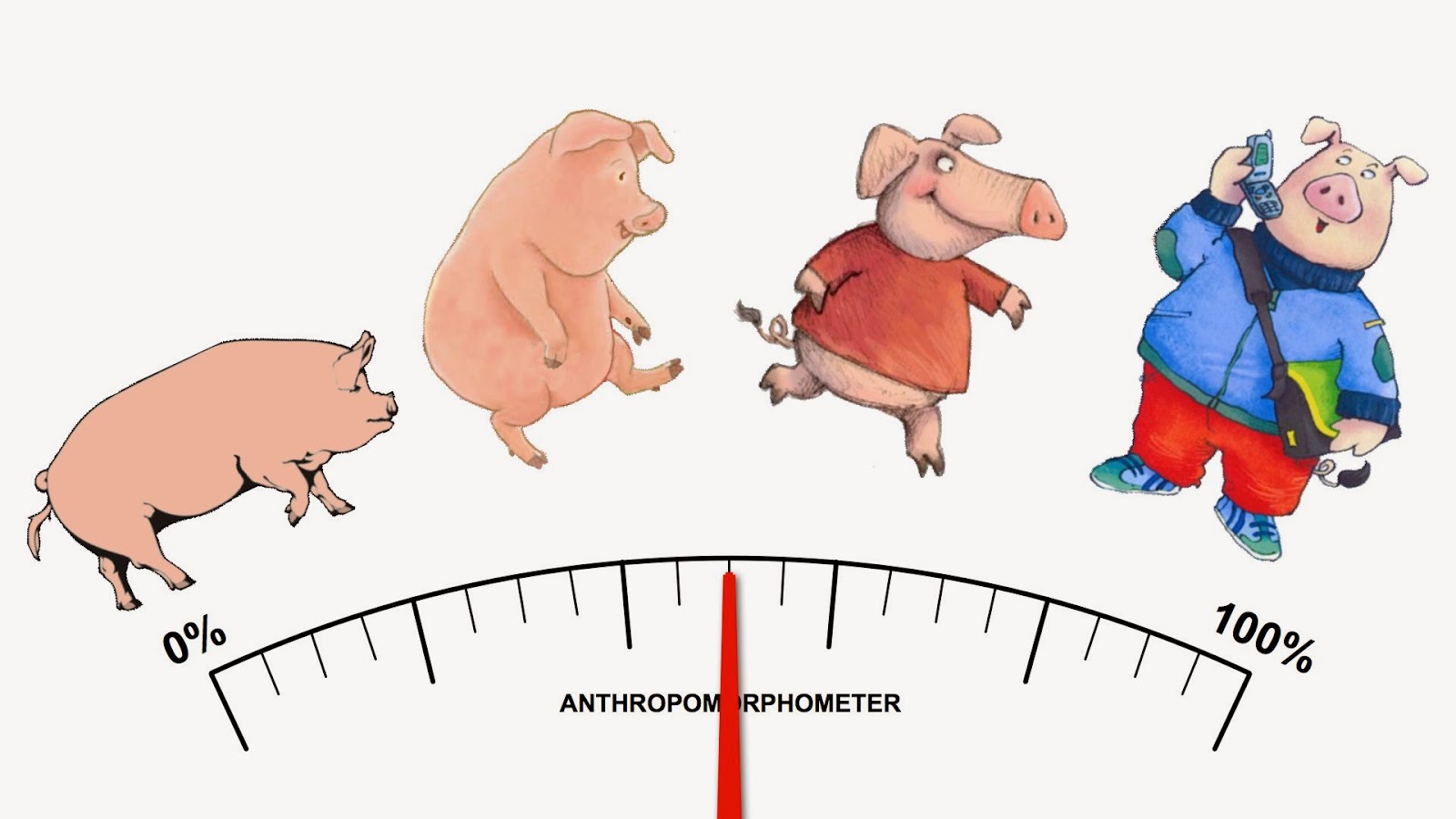
The “Pig Tales” session I often do on my school and library visits features three picture books I’ve written about pigs. In between reading the three stories I explain that one of the things that makes them different from each other is how much anthropomorphism they use. I explain what this ridiculously long word means and why it’s such a useful tool for storytellers.


The dictionary definition of anthropomorphism is “the attribution of human characteristics or behaviour to a god, animal, or object.” I tell the children that anthropomorphism is simply “making something more like a person.”

Many of mankind’s oldest stories come from Africa, the birthplace of the human race. In the African stories of Anansi the spider, Anansi thinks and speaks like a human and in some of the stories he takes on human form.

Anansi the Spider: A Tale from the Ashanti by Gerald McDermott

Storytellers have been using anthropomorphism – making animals think, talk and look like humans – ever since.

Lucy Cousins's Maisy Mouse

And it’s not just animals – you can anthropomorphise almost anything … 


… vegetables …


… vehicles …


… even household appliances!

One reason storytellers use anthropomorphism is because people usually find characters more appealing if they think they are like them. Anthropomorphising an animal or even a toaster makes us care about what happens to them.

Anthropomorphism is not an either-or option; you can vary the amount you use. And, if you are creating a picture book, it’s worth taking the time to get the balance just right in both text and illustrations.

You can use varying amounts of anthropomorphism

My picture book story Pigs Might Fly is a sequel to the traditional tale of The Three Little Pigs. The pigs in my story build and fly aeroplanes, so they are fully anthropomorphic – the story could just as well be about three humans. This was reflected in some of illustrator Steve Cox’s first character sketches for the book, where the pigs are fully clothed and one of them is carrying a phone and a laptop. However, the publisher felt that these characters didn’t have quite the right appeal, and the character designs that eventually appeared in the book wore less clothing and were more recognisably pig-like.

Some of Steve Cox's character sketches for Pigs Might Fly:
Early, fully-anthropomorphic characters on the left and final characters on the right.

The pig in The Pig’s Knickers lives outdoors on a farm and – before the events of the story – would not usually wear clothing. However I made him talk, think and feel like a human in the text and Vanessa Cabban’s illustrations show him dancing on his hind legs and picking things up with his front trotters. As such, he’s a good example of a semi-anthropomorphic character.

One of Vanessa Cabban's illustrations for The Pig's Knickers

The Princess and the Pig is the story of a piglet that gets switched at birth and is brought up as a princess in the mistaken belief that she has been bewitched. The running joke in the story is that, while the reader knows that Princess Priscilla is nothing more than an ordinary pig, the characters in the story don’t and spend all their time trying to make her look and behave like a human. When I first started thinking about the story I considered making Priscilla a little anthropomorphic, but in the end I decided that the story would be much funnier if I didn’t anthropomorphise her at all.

One of Poly Bernatene's spreads for The Princess and the Pig

So the next time you’re writing a story with animal* characters, take a moment to think about where’s the best place to draw your anthropomorphic line!


*Or vegetables or vehicles or household appliances!


My latest semi-anthropomorphic picture book is A Spot of Bother illustrated by Vanessa Cabban and published by Walker Books.


find your local bookshopBuy this book at amazon UKBuy at amazon US

Thursday, 5 February 2015

THE CLOCKWORK DRAGON • New Picture Book

They say 'good things come in threes'. Well, I have three books coming out today! Joining A Spot of Bother and Danny Dreadnought Saves the World is The Clockwork Dragon illustrated by Elys Dolan and published by Oxford Univeristy Press.

The Kingdom of Rodney is being terrorised by Flamethrottle the dragon. Fortunately Max, a young toymaker, and Lizzie, an armourer, are more than a match for this man-eating monster and the two of them come up with a clever plan to drive it away.

Here are a couple of spreads from the book.


And here's a trailer I made.


In the story, Max and Lizzie make their clockwork dragon out of recycled arms and armour and the story itself has also been recycled, not once, but twice!

The first version of the story was for a pop-up book, called Scraposaurus Wrecks, which I wrote, paper-engineered and illustrated. The Scraposaurus was a dinosaur made from scrap metal and the story ended with it being converted into a school bus after the old bus is wrecked as a result of the dad-driven-dinosaur’s exhibitionist antics. The book was never published, but the idea of driving around inside a huge metal creature was hugely appealing and I hoped to salvage it one day.

My cover art for Scraposaurus Wrecks,
a forerunner of The Clockwork Dragon.

A few years later, I was able to do that in a picture book called Tom’s Clockwork Dragon illustrated by Mark Oliver. Like Scraposaurus Wrecks, the story was about a giant reptile made from recycled metal, but this book had a different plot featuring two resourceful children who come up with a clever plan to rid their kingdom of a man-eating dragon.

One of Mark Oliver's illustrations for the original clockwork dragon book.

Unfortunately the book didn’t sell well and went out of print a couple of years after publication. Fortunately Oxford University Press decided to give the story a second chance by publishing a reworked version with a new illustrator. It’s very rare for a story to be recycled in this way and I’m very grateful to OUP editor Peter Marley for giving it a new lease of life.

As well as being re-illustrated, the story has been redrafted. If you’re familiar with the first version, you might notice that the scene with the king has been cut and a new scene added, where Flamethrottle (the man-eating dragon) wakes up in his cave. Another conspicuous change is that Tom, the young toymaker, has been renamed Max.

Although I’m still very fond of Mark Oliver’s illustrations for the original book, it made sense to find an illustrator with a distinctly different style for the new version. We considered several illustrators before settling on Elys Dolan, whose first picture book, the wonderful Weasels, had recently been published.

Elys has put a fresh new spin on the story, and her illustrations have greatly expanded upon the world in which it's set. You can find a map of this world - The Kingdom of Rodney – and portraits of some of it's colourful characters on the book's endpapers. Elys asked me for some names for the places she'd drawn and some local facts to go with them and these are included these, along with a smashing full colour version of Elys's map, in a Kingdom of Rodney Visitor's guide which you can download (for free!) here.

The Kindom of Rodney Visitor's Guide. CLICK HERE TO DOWNLOAD

If the town and castle in Elys's illustrations look familiar, that might be because they were inspired by her visit to Neuschwanstein, the home of Baron Bomburst in the film of Chitty Chitty Bang Bang. Elys didn't know this when she first drew the roughs, but Chitty Chitty Bang Bang is one of my all-time favourite films and has been a big influence on many of my stories, including The Clockwork Dragon, so I love this reference.

The architecture of Castle Crackpot and Cranktown were inspired by Neuschwanstein Castle
and the village of Hohenschwangau in Bavaria

I’m delighted with this new version of the story and I’m hoping that Elys and I will get to recycle the characters yet again in a second Max and Lizzie adventure. We already have a story in mind and if you study the last spread of the book (shown below) you might spot a clue to what it’s about.


This machine maze activity sheet is
also available as a free download.

Visit THE CLOCKWORK DRAGON'S page on my web site


find your local bookshopBuy this book at amazon UKBuy at amazon US

Monday, 2 February 2015

A Spot of Bother • Picture Book

I have a new picture book coming out this Thursday!

A Spot of Bother is illustrated by my longtime collaborator Vanessa Cabban and published by Walker Books. The story is a follow up to The Pig’s Knickers and features the same cast of characters including the rather self-centred Pig. In this story Pig is horrified to discover that his spotless appearance has been spoiled by a cherry stain. His friends try to help, but the more they try to clean the spot, the bigger it gets.

I knew as I was writing The Pig’s Knickers that I would want to revisit the characters, but my original intention was that each of the subsequent stories would be centred on a different animal. So the first follow-up story I wrote was about Sheep rather than Pig. However my publishers at Walker books didn’t feel that the Sheep story was quite right, so I wrote another story, this time with Goat as the central character. Once again Walker felt that the story fell short of the mark. So for the third attempt I returned to Pig and fortunately it turned out to be third time lucky!

Pig’s behaviour is as over-the-top as ever in this second story. When a squashed cherry leaves a bright red stain on his backside, he declares it to be a “monstrous misfortune”. But things go from really-not-that-bad to genuinely awful as Goat, Cow and Sheep try to help Pig rid himself of the ever spreading spot.

Here's a trailer for the book.


Vanessa did another great job on the book's illustrations, deftly capturing Pig’s emotions as he goes from satisfaction to despair and back again. Here are a couple of spreads.


I thought that the perfect activity sheet for this book would be a Spot to Spot.

Click image to download activity sheet

This is the seventh book that Vanessa Cabban and I did together and I'm extremely sad to say that it will be our last as Vanessa passed away shortly before Christmas. She was a good friend and a terrific illustrator to work with and I will miss her greatly.

Thursday, 29 January 2015

Danny Dreadnought Saves the World • Early Reader

I have a new early reader book coming out next week!

Danny Dreadnought Saves the World is illustrated by Martin Chatterton and is and my first book for Egmont's Bananas series.

Little Danny Dreadnought is fearless. So much so that his parents are worried about him and decide that he must learn to be afraid. But no matter what they try – skydiving, swimming with sharks, spending the night in a haunted house – Danny remains unshaken. Fortunately, when Earth is invaded by the fearsome Bugulons, Danny's fearlessness saves the day.

The story was inspired by the German folktale The Story of the Youth Who Went Forth to Learn What Fear Was, which was included in the collections of the Brothers Grimm. In that story a fearless youth sets out to learn how to shudder. After various adventures the youth spends three nights in a haunted castle and drives out its evil occupants, earning himself great riches and a princess’s hand in marriage. At the end of the story the princess finally makes the youth shudder by pouring a bucket of cold water, filled with fishes, over him.

Richard Wagner reinterpreted the story in Siegfried, his operatic retelling of the Norse myth of Sygurd, but gave it a far more satisfying ending. In Wagner’s opera, Siegfried finally learns what fear is when he mistakenly thinks that his sweetheart Brünnhilde is dead. And a similar ending was used by scriptwriter Anthony Minghella for Fearnot a 1988 TV adaptation of the Grimm’s tale for Jim Henson’s excellent Storyteller series. The Storyteller is one my family's favourite TV series. If you've never seen it, here's a clip.


I thought the plot could make a great picture book and set about adapting it to into a contemporary setting with the youth’s role being taken by a little girl, Daisy Dreadnought. My early drafts of the story were quite close to the Grimm original, with Daisy spending the night in a creepy castle, haunted by a trio of spiteful aristocratic spooks. The romantic Wagnerian ending wasn’t appropriate for such a young heroine, but I wanted an ending that felt similarly satisfying so, after banishing the ghosts from the castle, Daisy returns home to find her parents aren’t there. Thinking they’ve abandoned her, Daisy finally feels afraid, before her parents return home and allay her fears.

I sent this draft to several picture book publishers, but none were interested. One editor commented that the haunted house setting made it seem like a Halloween story, which would limit its appeal for the rest of the year. I still felt the story had potential so I did another draft. Bearing in mind the Halloween comment, I replaced the family of ghosts with an army of alien invaders – the fearsome Bugulons. I showed this revised version to publishers and, while none wanted it as a picture book, Egmont took it as a first reader for their Bananas series.

Adapting the story into a first reader was relatively easy. One of the nice things about the Bananas series is that, like picture books, they have full colour illustrations on every page. And, while the pages are smaller than those of a picture book, there are twice as many to tell the story in. One thing I had to change was Daisy’s gender. Editor Hannah Sandford explained to me that there were already lots of Bananas books featuring plucky heroines, so it would be nice to have a story with a plucky hero for a change – so Daisy became Danny!

A crestfallen Bugulon
Although the story features many scary situations, it’s meant to be funny, so I was keen that it should be illustrated by someone with a comical flair. I often suggest possible illustrators for my books and Martin Chatterton was one of the illustrators I suggested for Danny Dreadnought; I’ve always liked Martin’s style and knew that he’d already illustrated some Bananas books. So I was pleased that Egmont agreed that he’d be a good choice and delighted when Martin agreed to illustrate the book. Martin’s illustrations have exactly the whacky comic book feel that I was hoping for and I’m particularly pleased with the way he’s drawn the Bugulons, the intergalactic bullies who try to take over the Earth. His illustration of the Huge Scary Spaceship is magnificently menacing and I love the way he’s captured the Bugulon’s sense of disappointment and defeat at the end of the story.

Martin is also illustrating another story that I’ve written for the Bananas series, so I’m really looking forward to seeing what he does with that.

Here's a trailer for the book.


And if you're feeling particularly daring, you might like to try your hand at Danny's Scare Search puzzle.

Click the image to download the puzzle


find your local bookshop Buy this book at amazon UK Buy at amazon US