This blog is no longer being updated and has been replaced by my new blog at jonathanemmett.com/blog

Saturday, 24 May 2014

The Lauralympics and 'Real Life Cluedo'


My daughter Laura turned thirteen a couple of weeks ago and to mark the occasion we had a party-cum-sporting-contest called the Lauralympics. There were five events – Table football, Playstation Dance Mat, Beaker Knockdown, Kerplunk and Quickfire Quiz – with gold, silver and bronze medals being awarded for each event.

A couple of weeks before the party, the guests divided themselves into three teams. Each team was asked to come up with a team name, a team anthem (to be sung by the winning team at each event’s medal ceremony) and a team flag (to be hoisted as the anthem was sung). After some deliberation, the teams decided to call themselves the Teacup Turtles, the Mighty Morphing Unicorns and the Rainbow Poopin’ Rabbits.

We made t-shirts for each team using iron-on transfers, bought some plastic medals, and improvised a winners’ rostrum and a flagpole out of some plastic crates and the handle of a fruit-picker.

Here are some photos of this momentous sporting occasion.

"If you build it, they will come." The competition venue awaits

Each team made their own flag.

The Mighty Morphing Unicorns take on the Teacup Turtles at table football.

The girls had not used a dance mat before, so my wife gave them a tutorial.

My daughter proudly hoists the Rainbow Poopin' Rabbits Flag during a medals ceremony

It's only a matter of time before Kerplunk is included in the real Olympics.


You don't want to get between this girl and her stack of beakers!

Everything to play for in the final Quickfire Quiz event.


The Teacup Turtles

The Mighty Morphing Unicorns

The Rainbow Poopin' Rabbits

Real Life Cluedo

To add some extra fun to the proceedings we played a special Lauralympics version of Real Life Cluedo throughout the party.

Loosely based on the Cluedo board game, Real Life Cluedo is a great game to play if you’re staying with friends or family for a weekend. In the regular version of the game all the players are given three small pieces of paper. Each player writes their name on the first, an object that can be found around the house on the second and a room in the house on the third. Each of the three pieces of paper is folded and put into one of three bowls along with the other players pieces. The contents of the bowls are mixed up and then each player takes a piece of paper from each bowl. If a player draws their own name from the first bowl, they simply put it back and draw another. It doesn’t matter if a player picks out the same object or room that they put into the bowl.

Each player will now have a secret murder mission consisting of the name of another player, an object and a room. To win the game a player has to survive being "murdered", while murdering as many of the other players as possible, starting with the name they've just drawn.

For example, David has picked “Josie”, “Book” and “Kitchen” out of the bowls. David will have "murdered" Josie if she accepts or picks up a book while she’s in the kitchen. Josie must accept or pick up the book of her own accord - David can’t drop it into her lap or force it upon her in any other way. Once Josie has been murdered, she’s out of the game, but she passes on her own murder mission to David. If David completes Josie’s murder mission, he has to carry out the next victim’s mission and so on. If someone murders David, his murderer picks up David’s mission at that time.

If David murders a player who has a mission to murder him, he becomes a survivor and can stop playing. Depending on how the game plays out, a player may be able to murder all of the other players, but the game often results in a draw if two or more survivors succeed in murdering whoever is trying to murder them.

The regular version of the game described above can take days to play out and the Lauralympics only lasted a few hours. So to speed things up, I wrote the murder missions in advance and combined the objects and rooms on one piece of paper, choosing objects that would definitely be found in those rooms. To make it even easier, there was a choice of two rooms for each mission.

The murder missions we used for our simplified version of the game.

This simplified version of the game worked really well. One of the girls went on a killing spree, murdering six other players during the party before being murdered herself in the final half hour and we ended up with two survivors just before the party finished.


Friday, 2 May 2014

What gets me up in the morning

This post was originally published on CREATING FOCUS, the web site of occupational psychologist Sarah Dale. Occupational psychology is concerned with applying the science of psychology to work and this is one of a series of informal guest posts on Sarah's blog in which people from a range of professions talk about what motivates them in their work. You can follow Sarah on twitter on @creatingfocus.

WALLACE'S BED LAUNCHER
Sadly, I don't have a contraption like this to get me up in the morning; I have to rely on low-tech self-motivation

As a self-employed author who works from home, I’m often asked how I’m able to motivate myself. I’ve been a professional children’s author and pop-up designer for almost twenty years now. I love my work and consider myself extremely fortunate to be able to make a living out of it and this sense of “precarious good fortune” is the main thing that gets me out of bed and sitting at my desk every morning.

I have bad days when the story I’m working on feels clunky and awkward or I run up against what seems like an insurmountable obstacle in the plot. If this goes on for more than a few days, I usually put that story aside and work on something else for a while. Then, when I go back to it, I can often see it from a fresh angle that enables me to resolve the problem.

Pop-up design is different. If I haven’t got a pop-up working properly by the end of the day, my mind usually stays focussed on the problem and I want to keep going back to it until I’ve found a solution. Motivation is rarely an issue with pop-up design and an unproductive day often spurs me to redouble my efforts the following day.

People sometimes assume that once an author has a couple of successful books under their belt, everything they subsequently write is automatically accepted for publication. This may be the case for a few big names, but for many professional authors their tenth book can be as difficult to get published as their first. When I’m not writing, a lot of my time is spent trying to persuade publishers to take my work. Despite this effort, most of the stories I write are never published!

I often joke that being a children’s author is preferable to having a “proper job” but, while I can’t claim to have gone into the profession for anything other than selfish reasons, I think children’s authors can make a real difference to people’s lives. Good children’s literature is essential for the development of children’s literacy and good literacy is the key to wider academic achievement. If one can engage a child’s enthusiasm for literature at an early age, they’ll have a head start for life.

The problem is many young children, particularly boys, can’t find books that appeal to them as much as other children’s media currently do. The picture book industry’s current standards of age-appropriateness are more conservative than those of children’s films, TV and video games and this has resulted in many children coming to regard the former as being a lot less “cool” and appealing than the latter. I believe that this difference in standards is linked to a lack of gender balance in the world of picture books, where female gatekeepers hugely outnumber males. About eighteen months ago I decided to devote some of my time to raising awareness of the issue and set up a site called COOLnotCUTE.com to try to start a debate. It’s a contentious campaign and – as well as being a reason for me getting up in the morning – it’s also been a reason for me losing sleep in the night.

I’m not a natural campaigner, but in the last few years I’ve found myself taking a more proactive approach to change and, instead of waiting for someone else to highlight an issue or organise something, I’ve become more inclined to do it myself.

Another side project I’ve recently embarked on is virtualauthors.co.uk, a web directory of children’s authors and illustrators available for free Skype visits to UK schools. Skype visits are a great way for authors to connect with young readers and are already very popular in the US. I’m hoping that virtualauthors.co.uk will help to make Skype visits equally popular in the UK.

So right now I have no shortage of things that make it worth getting up in the morning – and I haven’t even mentioned my family! Long may it continue.

Monday, 10 March 2014

VirtualAuthors.co.uk - a new web site for virtual author visits for UK schools.

It was World Book Day last week and like many authors I visited a school to read my books and talk to the children. School visits are a great way for authors and illustrators to connect directly with young readers and are usually inspiring experiences for both.

Like most authors I charge a fee for my school visits that covers the time spent preparing my sessions as well as the time spent at the school. Unfortunately, with budgets being tight in most state schools, such fees deter many schools from booking author visits. The problem is particularly acute for small schools in rural communities where the cost of the visit on a per child basis can be three or four times that for a child attending a larger urban school.

My own school visits have been further restricted in recent years by my decision to limit them to schools in my local East Midlands area. My family have kept a household carbon budget since 2005, set slightly below the national household average. As well as forgoing air travel for our family holidays, we try to curb our long-distance travel generally which has meant me declining invitations to visit schools that are further afield.

You might think that with this tightening of both schools’ financial budgets and my own carbon budget, the number of school visits I do must be dwindling. In fact, I've visited more schools and in more far flung places in the last year than I have in any previous year, thanks to the internet.

Eighteen months ago, two US school children emailed me to ask if I’d Skype with their elementary class in North Carolina to read my picture book The Princess and the Pig and answer some of the class's questions about it. I was aware that many US authors offered Skype visits and had already been considering offering them myself, so I said I'd be happy to give it a go. The visit went so well that I've been virtually visiting schools, mostly in the US, ever since. Some of the schools I've visited have not had an author visit of any kind before and every school has been very appreciative. Teachers often follow up with classroom activities and schools have sent me letters, drawings and even an ebook the children created in response to my visit.

My virtual visits to schools in Vermont and Atlanta

The growth of virtual author visits in the US has been helped by the “Authors who Skype” page set up by Kate Messner and the Skype an Author site run by Mona Kerby and Sarah Chauncy, which include directories of authors and illustrators available to Skype with US schools. So I’ve decided to set up a similar directory site for authors and illustrators willing to Skype with UK schools at virtualauthors.co.uk.

For the time being, I’m following Kate Messner’s example and only listing authors that offer free 15-20 minute visits (although listed authors and illustrators might also offer longer, paid-for visits in addition to these). While I’m generally wary of the notion that authors and illustrators should work for free, a short virtual visit needs little preparation, the overheads are minimal (providing you already have a computer with a broadband connection) and there are no travel or accommodation expenses. In practice, it can take no more time to virtually visit a whole class of children than it takes to respond to a letter or email from a single child - and I don’t charge a fee to do that! Nevertheless, I still need to earn a living, so I limit my virtual visits to one a week and I only do them on Wednesdays. Even if an author or illustrator can only spare the time to do one free virtual visit a month during term time, that's still 10 schools a year, some of which may never have been visited by an author or illustrator before.

If you’re an author or illustrator that would like to be listed in the directory you can fill out the form on the "Authors and Illustrators" page of the site. If you've never done a Skype visit, there is some advice on getting started and some graphics you can download on the same page. There is no charge for being listed in the directory.

At present I’m restricting the directory to authors and illustrators who currently have at least one traditionally published book in print in the UK (not at the author or illustrator's expense and not only as print-on-demand/ebook). However I’m happy to list authors and illustrators from outside the UK providing they are able to offer free visits to UK schools during regular school hours.

So far, most of my virtual visits have been to US schools, but I have visited a couple of schools in the UK. Here’s what they had to say about the experience.

"The skype session was fantastic and the children really enjoyed it. It was great to be able to get the children to write questions and then have answers to them. I would certainly recommend it to other teachers. The parents all heard about it when their children got home from school and it certainly impressed them." 
Cossington C of E Primary School, Leicestershire, UK

“We thought the session was fantastic - just what we needed, a real life author to give out the messages we continually say … It is a brilliant opportunity to speak with you virtually and move into the 21st century! … The session was very clear and just the right time for year 3.” 
Corrie Primary School, Manchester, UK 

I’m hoping that virtualauthors.co.uk will encourage more schools to invite authors and illustrators into their classrooms. And who knows, once they’ve seen the benefits of a brief virtual visit, they might book a few more actual author and illustrator visits too!


Visit the virtual visits page on my own web site


UPDATE March 2017: The Virtual Authors site now lists authors who are available to Skype for a fee in addition to those offering free sessions. 

UPDATE September 2020: The Virtual Authors site now lists authors who are available to use software other than Skype, such as Zoom, FaceTime, Google Meet or Microsoft Teams. 

Friday, 14 February 2014

THE PRINCESS AND THE PIG is my most borrowed book from UK libraries

The Princess and the Pig
was my most borrowed book
I recently received last year's UK library loans figures for my books, courtesy of the Public Lending Right (PLR) organisation.

There's been quite a shakeup among my most borrowed books, with three books appearing in the top 5 for the first time, including The Princess and the Pig, which knocked last year's most borrowed book Bringing Down the Moon, off the top spot.

My latest Mole and Friends picture book, A Secret Worth Sharing and piratical picture book, The Treasure of Captain Claw, also made it into the top 5 for the first time.

The PLR figures show that my books were borrowed from UK libraries a total of 208,308 times last year, slightly up from 204,491 loans the previous year.

Here are my top 5 most borrowed books.

Position
Book Title
Nº of Loans

1 The Princess and the Pig 17,330
2
14,922
3 A Secret Worth Sharing 13,868
4 The Treasure of Captain Claw 13,388
5
13,183
  
The PLR organisation also publishes a list of the UK's Most Borrowed Authors and I've crept up 9 places in this to 171st place. The top 3 remain the same this year with US crime writer James Patterson in first place,  "Daisy Meadows" (the pseudonym used by a collection of authors who write the Rainbow Magic series) in second place and Julia Donaldson in third.

Wednesday, 12 February 2014

Who wants to be a milliner?

I've spent quite a lot of time thinking about hats recently, so I thought I'd write a quick blog post about it.

This hat, which I recently spotted on the Independent's web site, had me suffering from hat envy.

A few weeks ago, Sure Start librarian Jan Nicholson got in touch to tell me that she was trying to make a replica of the double-pointed hat that illustrator Poly Bernatene had shown Priscilla the pig wearing in our picture book  The Princess of the Pig. The hat and the book were to be a birthday present for a colleague, who was also called Priscilla.


Jan was planning to make the hat out of paper and was hoping that, as a paper-engineer, I might be able to give her a bit of advice on how to go about it. The hat is made up of two intersecting cones, so I sent her this diagram with some basic instructions to get her started.


After a lot of trial and error Jan managed to make the rather marvellous piece of millinery that the real life Priscilla can be seen sporting below.

The real life Priscilla in her new hat!

At the same time as Jan was putting the finishing touches to her Priscilla hat, I was making my own replica hat inspired by another picture book I'd done with Poly Bernatene. My hat was to be a copy of Captain Cut-throat's hat from Here be Monsters.

The villainous Captain Cut-Throat in his pirate hat

I'd already made a version of the Captain's hat for the book's trailer, but that one was made out of paper and I needed something that was more durable that I could fold up and pack into a bag for school and library visits.

I made a paper Captain Cut-Throat hat for the book's trailer.

After googling around for a bit, I came across milliner Claire Strickland's website which had a page of useful advice on how to make hats out of plastazote foam, an ideal material for my pirate hat. 


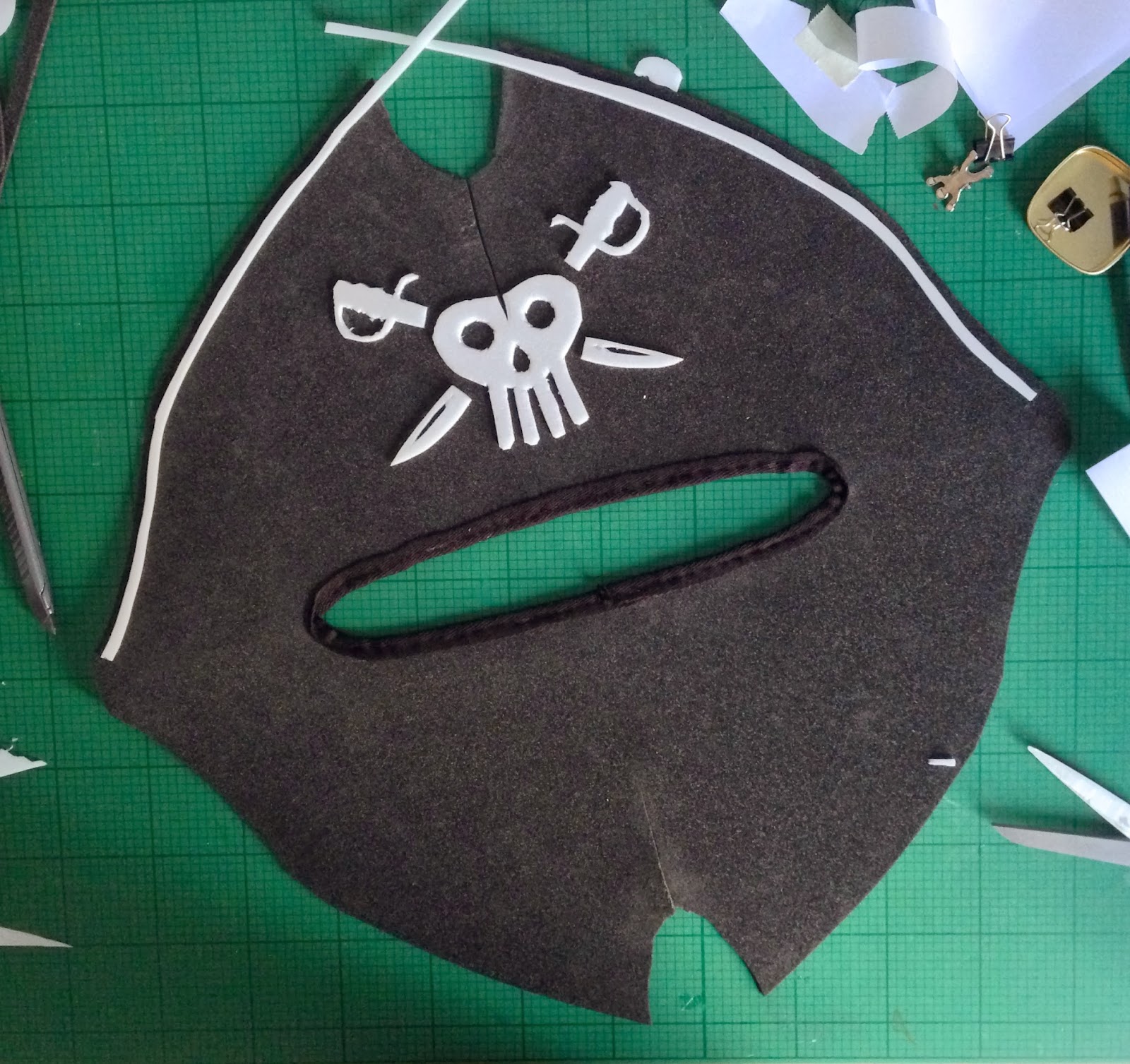
I started off by making a paper version of the hat to get the right shape and size to fit my head. Then I used this as a template to cut out a piece of 3mm thick black plastazote.


Although plastazote is quite tough, I was worried it might tear with continued use, so I stitched some sewing tape around the hat's opening to reinforce it.


Rather than paint the skull and cutlass symbol onto the foam, I cut it and the edging strip out of white plastazote and glued it in place with contact adhesive. To give the hat a little shape I also cut and glued a small pleat in the crown.


Then I folded the hat in half and glued the edges together to make a cornish pasty like shape. I used a couple of heavy books to keep the edges pressed together while they dried.


The hat was finished …


… but when I tried it on I was a little disappointed with the overall effect. I didn't look quite as piratey as I wanted to. There was something missing. I decided that I really needed a swashbuckling moustache as well.


So I used the plastazote offcuts to make a selection of moustaches.


And when the hat had its first outing, for my Here be Monsters events on National Libraries Day, I let the audience vote for which moustache I should wear.


Tuesday, 28 January 2014

National Libraries Day Events - Chesterfield and Brimington Libraries, Saturday 8th February 2014

Did you know that Saturday 8th February 2014 is National Libraries Day?

The aim of the day is to encourage people to use their local libraries and find out about the services they have to offer. There are events going on in libraries all over the United Kingdom. You can find out if there's an event in a library near you using the map on the National Libraries Day web site.

If you live near Chesterfield or Brimington Libraries in Derbyshire you might like to come along to one of my FREE events. I'll be reading my new piratical picture book Here Be Monsters, illustrated by Poly Bernatene, and talking about monsters and maps.


Here's a trailer I made about the book.


We'll be drawing maps of monster-infested islands and one lucky treasure hunter at each event will win a signed copy of the book.

Fill in your own treasure map and if you can guess where the treasure is hidden
you could win a signed copy of Here Be Monsters.

TICKETS ARE FREE and available from each library, but there are limited numbers for each event so please request them in advance. The events are suitable for children aged five and over.

EVENT DETAILS


Saturday 8th February

Brimington Library 
11.00 am - 12.00 noon

Church Street
Brimington
Chesterfield
Derbyshire
S43 1JG

Tel: 01246 271547
email: brimington.library@derbyshire.gov.uk


Saturday 8th February

Chesterfield Library 
14.15 pm – 15.15 pm

New Beetwell Street 
Chesterfield 
Derbyshire 
S40 1QN

Tel: 01629 533 400 
email: chesterfield.library@derbyshire.gov.uk


Visit my web site to find out more about HERE BE MONSTERS


Visit the National Libraries Day web site

Monday, 27 January 2014

Monstermatic Competition Winners

Earlier this month, Macmillan published a Let's Read edition of my picture book MONSTERS: An Owner's Guide. The book is illustrated by Mark Oliver and features Shambles, one of a range of self-assembly, fully-interactive, mechanical monsters produced by the Monstermatic Company.

To mark the publication, I ran a prize competition and asked readers to send me their own monster drawings. I received a collection of monstrous masterpieces from creature creators of all ages. Here they all are.

Scroll down to the bottom (if you're brave enough to go past so many monsters) to see who's won!

Tim Budgeon's helpful and mischievous UGGIE
Emma Collins sent me a selection of monsters
ELEMONSTER, part elephant, part monster
was created by the Yewman younglings. 
This looming monstrosity was created by Charlotte
The magnificently titled HUNGRY TOOTH SCARY was created by Esther Lacey
LUMMOX, the monster that despite his size,
just wants to fit in, was sent in by Kyle Andersen
FLUFFBALL by Rowan, age 6, can make his arms longer and shorter 
EGGLEGS, by Emer, age 8, can swap his head over
This is PLODASAURUS (he likes to plod)
by Lily Slaymaker, age 8
 FLIBBERSTOMP from J aged 4 

There's some terrific artwork there, so a big THANK YOU to everyone who sent something in.

I'm giving two signed copies of the book as prizes.

The first goes to the creator of my favourite monster, which is EGGLEGS, by Emer. It's a great design with a nice variety of body parts –  tentacle arms, spindly legs, batwing ears. And the interchangeable head is a great feature for a Monstermatic product!

The second winner, picked at random from the remaining entries (using the random number generator here) is the smashing selection of monsters sent in by Emma Collins.


The two winners!