This blog is no longer being updated and has been replaced by my new blog at jonathanemmett.com/blog

Monday, 10 March 2014

VirtualAuthors.co.uk - a new web site for virtual author visits for UK schools.

It was World Book Day last week and like many authors I visited a school to read my books and talk to the children. School visits are a great way for authors and illustrators to connect directly with young readers and are usually inspiring experiences for both.

Like most authors I charge a fee for my school visits that covers the time spent preparing my sessions as well as the time spent at the school. Unfortunately, with budgets being tight in most state schools, such fees deter many schools from booking author visits. The problem is particularly acute for small schools in rural communities where the cost of the visit on a per child basis can be three or four times that for a child attending a larger urban school.

My own school visits have been further restricted in recent years by my decision to limit them to schools in my local East Midlands area. My family have kept a household carbon budget since 2005, set slightly below the national household average. As well as forgoing air travel for our family holidays, we try to curb our long-distance travel generally which has meant me declining invitations to visit schools that are further afield.

You might think that with this tightening of both schools’ financial budgets and my own carbon budget, the number of school visits I do must be dwindling. In fact, I've visited more schools and in more far flung places in the last year than I have in any previous year, thanks to the internet.

Eighteen months ago, two US school children emailed me to ask if I’d Skype with their elementary class in North Carolina to read my picture book The Princess and the Pig and answer some of the class's questions about it. I was aware that many US authors offered Skype visits and had already been considering offering them myself, so I said I'd be happy to give it a go. The visit went so well that I've been virtually visiting schools, mostly in the US, ever since. Some of the schools I've visited have not had an author visit of any kind before and every school has been very appreciative. Teachers often follow up with classroom activities and schools have sent me letters, drawings and even an ebook the children created in response to my visit.

My virtual visits to schools in Vermont and Atlanta

The growth of virtual author visits in the US has been helped by the “Authors who Skype” page set up by Kate Messner and the Skype an Author site run by Mona Kerby and Sarah Chauncy, which include directories of authors and illustrators available to Skype with US schools. So I’ve decided to set up a similar directory site for authors and illustrators willing to Skype with UK schools at virtualauthors.co.uk.

For the time being, I’m following Kate Messner’s example and only listing authors that offer free 15-20 minute visits (although listed authors and illustrators might also offer longer, paid-for visits in addition to these). While I’m generally wary of the notion that authors and illustrators should work for free, a short virtual visit needs little preparation, the overheads are minimal (providing you already have a computer with a broadband connection) and there are no travel or accommodation expenses. In practice, it can take no more time to virtually visit a whole class of children than it takes to respond to a letter or email from a single child - and I don’t charge a fee to do that! Nevertheless, I still need to earn a living, so I limit my virtual visits to one a week and I only do them on Wednesdays. Even if an author or illustrator can only spare the time to do one free virtual visit a month during term time, that's still 10 schools a year, some of which may never have been visited by an author or illustrator before.

If you’re an author or illustrator that would like to be listed in the directory you can fill out the form on the "Authors and Illustrators" page of the site. If you've never done a Skype visit, there is some advice on getting started and some graphics you can download on the same page. There is no charge for being listed in the directory.

At present I’m restricting the directory to authors and illustrators who currently have at least one traditionally published book in print in the UK (not at the author or illustrator's expense and not only as print-on-demand/ebook). However I’m happy to list authors and illustrators from outside the UK providing they are able to offer free visits to UK schools during regular school hours.

So far, most of my virtual visits have been to US schools, but I have visited a couple of schools in the UK. Here’s what they had to say about the experience.

"The skype session was fantastic and the children really enjoyed it. It was great to be able to get the children to write questions and then have answers to them. I would certainly recommend it to other teachers. The parents all heard about it when their children got home from school and it certainly impressed them." 
Cossington C of E Primary School, Leicestershire, UK

“We thought the session was fantastic - just what we needed, a real life author to give out the messages we continually say … It is a brilliant opportunity to speak with you virtually and move into the 21st century! … The session was very clear and just the right time for year 3.” 
Corrie Primary School, Manchester, UK 

I’m hoping that virtualauthors.co.uk will encourage more schools to invite authors and illustrators into their classrooms. And who knows, once they’ve seen the benefits of a brief virtual visit, they might book a few more actual author and illustrator visits too!


Visit the virtual visits page on my own web site


UPDATE March 2017: The Virtual Authors site now lists authors who are available to Skype for a fee in addition to those offering free sessions. 

UPDATE September 2020: The Virtual Authors site now lists authors who are available to use software other than Skype, such as Zoom, FaceTime, Google Meet or Microsoft Teams. 

Friday, 14 February 2014

THE PRINCESS AND THE PIG is my most borrowed book from UK libraries

The Princess and the Pig
was my most borrowed book
I recently received last year's UK library loans figures for my books, courtesy of the Public Lending Right (PLR) organisation.

There's been quite a shakeup among my most borrowed books, with three books appearing in the top 5 for the first time, including The Princess and the Pig, which knocked last year's most borrowed book Bringing Down the Moon, off the top spot.

My latest Mole and Friends picture book, A Secret Worth Sharing and piratical picture book, The Treasure of Captain Claw, also made it into the top 5 for the first time.

The PLR figures show that my books were borrowed from UK libraries a total of 208,308 times last year, slightly up from 204,491 loans the previous year.

Here are my top 5 most borrowed books.

Position
Book Title
NÂș of Loans

1 The Princess and the Pig 17,330
2
14,922
3 A Secret Worth Sharing 13,868
4 The Treasure of Captain Claw 13,388
5
13,183
  
The PLR organisation also publishes a list of the UK's Most Borrowed Authors and I've crept up 9 places in this to 171st place. The top 3 remain the same this year with US crime writer James Patterson in first place,  "Daisy Meadows" (the pseudonym used by a collection of authors who write the Rainbow Magic series) in second place and Julia Donaldson in third.

Wednesday, 12 February 2014

Who wants to be a milliner?

I've spent quite a lot of time thinking about hats recently, so I thought I'd write a quick blog post about it.

This hat, which I recently spotted on the Independent's web site, had me suffering from hat envy.

A few weeks ago, Sure Start librarian Jan Nicholson got in touch to tell me that she was trying to make a replica of the double-pointed hat that illustrator Poly Bernatene had shown Priscilla the pig wearing in our picture book  The Princess of the Pig. The hat and the book were to be a birthday present for a colleague, who was also called Priscilla.


Jan was planning to make the hat out of paper and was hoping that, as a paper-engineer, I might be able to give her a bit of advice on how to go about it. The hat is made up of two intersecting cones, so I sent her this diagram with some basic instructions to get her started.


After a lot of trial and error Jan managed to make the rather marvellous piece of millinery that the real life Priscilla can be seen sporting below.

The real life Priscilla in her new hat!

At the same time as Jan was putting the finishing touches to her Priscilla hat, I was making my own replica hat inspired by another picture book I'd done with Poly Bernatene. My hat was to be a copy of Captain Cut-throat's hat from Here be Monsters.

The villainous Captain Cut-Throat in his pirate hat

I'd already made a version of the Captain's hat for the book's trailer, but that one was made out of paper and I needed something that was more durable that I could fold up and pack into a bag for school and library visits.

I made a paper Captain Cut-Throat hat for the book's trailer.

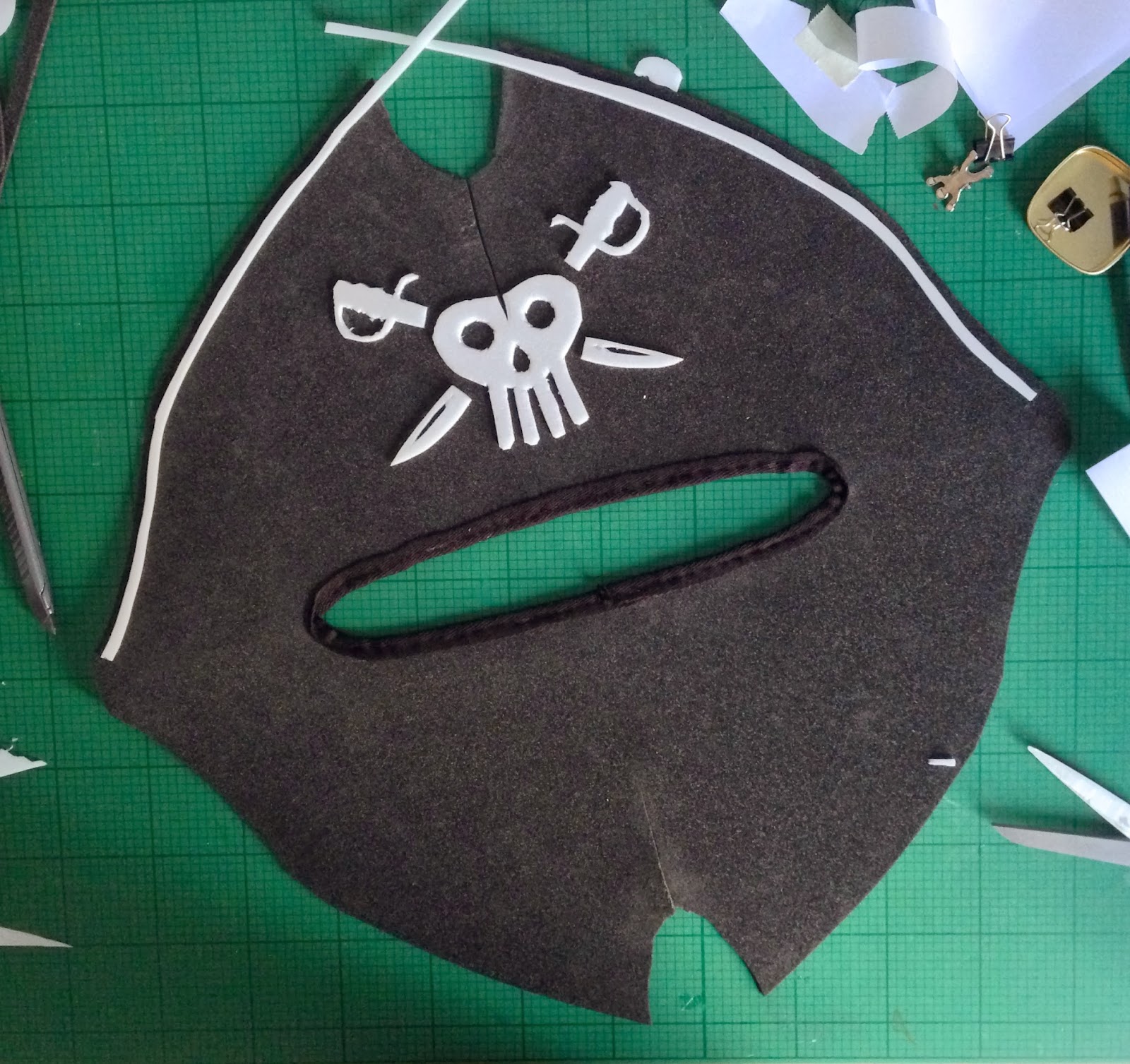
After googling around for a bit, I came across milliner Claire Strickland's website which had a page of useful advice on how to make hats out of plastazote foam, an ideal material for my pirate hat. 


I started off by making a paper version of the hat to get the right shape and size to fit my head. Then I used this as a template to cut out a piece of 3mm thick black plastazote.


Although plastazote is quite tough, I was worried it might tear with continued use, so I stitched some sewing tape around the hat's opening to reinforce it.


Rather than paint the skull and cutlass symbol onto the foam, I cut it and the edging strip out of white plastazote and glued it in place with contact adhesive. To give the hat a little shape I also cut and glued a small pleat in the crown.


Then I folded the hat in half and glued the edges together to make a cornish pasty like shape. I used a couple of heavy books to keep the edges pressed together while they dried.


The hat was finished …


… but when I tried it on I was a little disappointed with the overall effect. I didn't look quite as piratey as I wanted to. There was something missing. I decided that I really needed a swashbuckling moustache as well.


So I used the plastazote offcuts to make a selection of moustaches.


And when the hat had its first outing, for my Here be Monsters events on National Libraries Day, I let the audience vote for which moustache I should wear.


Tuesday, 28 January 2014

National Libraries Day Events - Chesterfield and Brimington Libraries, Saturday 8th February 2014

Did you know that Saturday 8th February 2014 is National Libraries Day?

The aim of the day is to encourage people to use their local libraries and find out about the services they have to offer. There are events going on in libraries all over the United Kingdom. You can find out if there's an event in a library near you using the map on the National Libraries Day web site.

If you live near Chesterfield or Brimington Libraries in Derbyshire you might like to come along to one of my FREE events. I'll be reading my new piratical picture book Here Be Monsters, illustrated by Poly Bernatene, and talking about monsters and maps.


Here's a trailer I made about the book.


We'll be drawing maps of monster-infested islands and one lucky treasure hunter at each event will win a signed copy of the book.

Fill in your own treasure map and if you can guess where the treasure is hidden
you could win a signed copy of Here Be Monsters.

TICKETS ARE FREE and available from each library, but there are limited numbers for each event so please request them in advance. The events are suitable for children aged five and over.

EVENT DETAILS


Saturday 8th February

Brimington Library 
11.00 am - 12.00 noon

Church Street
Brimington
Chesterfield
Derbyshire
S43 1JG

Tel: 01246 271547
email: brimington.library@derbyshire.gov.uk


Saturday 8th February

Chesterfield Library 
14.15 pm – 15.15 pm

New Beetwell Street 
Chesterfield 
Derbyshire 
S40 1QN

Tel: 01629 533 400 
email: chesterfield.library@derbyshire.gov.uk


Visit my web site to find out more about HERE BE MONSTERS


Visit the National Libraries Day web site

Monday, 27 January 2014

Monstermatic Competition Winners

Earlier this month, Macmillan published a Let's Read edition of my picture book MONSTERS: An Owner's Guide. The book is illustrated by Mark Oliver and features Shambles, one of a range of self-assembly, fully-interactive, mechanical monsters produced by the Monstermatic Company.

To mark the publication, I ran a prize competition and asked readers to send me their own monster drawings. I received a collection of monstrous masterpieces from creature creators of all ages. Here they all are.

Scroll down to the bottom (if you're brave enough to go past so many monsters) to see who's won!

Tim Budgeon's helpful and mischievous UGGIE
Emma Collins sent me a selection of monsters
ELEMONSTER, part elephant, part monster
was created by the Yewman younglings. 
This looming monstrosity was created by Charlotte
The magnificently titled HUNGRY TOOTH SCARY was created by Esther Lacey
LUMMOX, the monster that despite his size,
just wants to fit in, was sent in by Kyle Andersen
FLUFFBALL by Rowan, age 6, can make his arms longer and shorter 
EGGLEGS, by Emer, age 8, can swap his head over
This is PLODASAURUS (he likes to plod)
by Lily Slaymaker, age 8
 FLIBBERSTOMP from J aged 4 

There's some terrific artwork there, so a big THANK YOU to everyone who sent something in.

I'm giving two signed copies of the book as prizes.

The first goes to the creator of my favourite monster, which is EGGLEGS, by Emer. It's a great design with a nice variety of body parts –  tentacle arms, spindly legs, batwing ears. And the interchangeable head is a great feature for a Monstermatic product!

The second winner, picked at random from the remaining entries (using the random number generator here) is the smashing selection of monsters sent in by Emma Collins.


The two winners!

Saturday, 4 January 2014

“MONSTERS - An Owner’s Guide” PRIZE COMPETITION

I’m always sad to see one of my books go out of print, but I was particularly sorry when MONSTERS - An Owner’s Guide, the picture book created by myself and illustrator Mark Oliver, went out of print a couple of years ago as the book had proved very popular on school visits and had quickly become one of my most borrowed books from UK libraries.

So I was delighted when publisher Macmillan told me that they were giving the book a second chance by publishing it as part of their Let’s Read mini-picture book series. Although written in rhyme, the book is set out like a user’s manual, so it’s well suited to Let’s Read’s smaller handbook-like format.
Some important Dos and Don’ts to remember when using your monster.

To celebrate the book coming back into print, I’m running a PRIZE COMPETITION! Shambles, the mechanical monster featured in the book is just one of a range produced by the Monstermatic Company. Here they all are.


The full range of Monstermatic Monsters (click image to enlarge).

To have a chance of winning a signed copy of the new edition, send me your own sketch of a new Monstermatic Monster – and don't forget to give it a name! The competition is open to all ages, so get your little monsters drawing too!

I’ll post all the entries on this blog and pick two winners, who’ll each receive a copy of the book. One copy will go to the creator of my favourite monster sketch and the other will be chosen at random. You can send me your monsters in the following ways:
  • Twitter: Tweet your monster picture to @ScribbleStreet including the hashtag #Monstermatic
  • Monstermatic Transfer: Draw your picture on a sheet of paper and then feed it into the mouth of any Monstermatic Monster while shouting my name repeatedly into the monster's ear / auditory orifice.*
The competition will close on Sunday 26th January 2014 and the winners will be announced shortly after.


Find out more about the book at my web site


find your local bookshopBuy this book at amazon UK

*Please note that I accept no liability should an entrant come to any harm as a result of attempting this.

Thursday, 19 December 2013

Christmas is coming - and so is the Puzzle Elf's Treasure Hunt!

Christmas day in the Emmett household always begins with a treasure hunt. It started when the kids were little and has since become a family tradition. It’s not one of those treasure hunts where clues or riddles lead you to particular objects (although we love doing those too) - it’s more like a quiz with an element of Hunt the Thimble. I thought I’d write a post about it in case anyone fancied doing something similar.

Every Christmas morning the family come downstairs to find all of the presents have been taken from under the Christmas tree and moved into a locked "Treasure Room" at the back of the house. This is the work of the Puzzle Elf, one of Santa's lesser known little helpers with a propensity for tricksy questions.

A rare photo of the original Puzzle Elf, caught shortly after he hid his letter in our Christmas Tree.

Hidden somewhere on the Christmas tree is a letter from the Elf, along with a gridded map showing both floors of the house and a piece of paper with two questions written on it.

The Puzzle Elf’s treasure map.

The questions always come in pairs with five multiple choice answers for each. Each question is for a particular member of the family. For some reason the Puzzle Elf never sets me any questions — I assume it's because she thinks I’m either far too clever or far too stupid. One set of answers in each pair of questions is accompanied by a set of letters, the other by a set of numbers. The correct answers to both questions will give a grid reference on the map (e.g. E-5) where another pair of questions is hidden. There are always 12 questions in all (6 pairs), the topics are always books, movies, science and history with each family member getting a question on each topic.

Here are some of the Puzzle Elf’s questions from last Christmas

The last pair of questions reveals the location of the key to the Treasure Room. When the key has been found and the Treasure Room has been unlocked, the family can open their presents.

The key is wrapped in a piece of paper. 

It usually takes about an hour to find the key but both our kids insist that the Puzzle Elf keeps coming each year.


If you think your family might enjoy doing a similar treasure hunt (you don’t have to do it at Christmas), here are a few tips.

  • It’s nice to find a key, but If you don’t have a room, cupboard or wardrobe you can lock the presents in, the final piece of paper could simply reveal where the presents are hidden (e.g. In the garden shed or under mum and dad's bed).
  • The map of the house doesn’t need to be as neatly drawn as the one shown above (I suspect that the Puzzle Elf, like me, used to be an architect). A hand drawn map on squared paper will do just as well, but make sure each grid square only covers a small area of the floor plan as the larger the grid square, the larger the area of house that will need to be searched.
  • Try to pick questions that only the family member they're addressed to will know the answer to so that everyone will feel they have played a part in finding the treasure. The Puzzle Elf usually sets questions on books and films that family members have read or watched in the last year or topics they’ve been studying at school. If your family is especially bookish, all of the questions could be about books. 
  • Clues can be held in place with sticky tape or Blu-Tack, but should be in plain sight, so that searchers don’t have to move or open anything to find them, although they may have to look underneath or around the back of an object. 

The Puzzle Elf rolls the clues up into tight scrolls to make them more difficult to spot.

In our house, the first clue and map are always accompanied by a letter from the Puzzle Elf. The Puzzle Elf's job has changed hands over the years. The original Puzzle Elf went on paternity leave a few years back and that year the Easter Bunny had to cover for him. However he was back at work the next year and was training up his daughter, Flummox, as an apprentice. The original elf has now retired and Flummox has taken over from him.

If your family are the doing the treasure hunt for the first time, it’s a good idea to include some sort of letter with instructions. Here’s some instructions from one of the original Puzzle Elf’s letters that you can adapt for your own use:
Santa has put all your presents in the Treasure Room at the back of the house. He has locked the room and hidden the key somewhere safe. To make sure that you - and only you - can find the key, he has set a treasure hunt that only the three of you, working together, can solve. 
There are 6 pairs of multiple-choice questions. 
The two answers to each pair will give you a grid reference on the house plan provided. 
The next pair of questions can be found somewhere in that location. 
The questions are divided into three groups and each of you will have to answer 4 questions each. 
The final pair of questions will give you the location of the key. 
Good luck and happy hunting!
If the Puzzle Elf has inspired you to do your own treasure hunt, do let me know - and I'll pass the message on to her! And if you already have your own Christmas treasure hunt, I’d love to hear about that too.